Have you ever looked at your CRM and wondered which leads are actually worth your sales team’s time? Many businesses generate enquiries every week but still struggle to identify who is genuinely ready to buy. Without a clear system, sales teams often waste hours chasing cold prospects while high-quality opportunities slip through the cracks. That is exactly why salesforce lead scoring has become such an important strategy for growing businesses in 2026.
At Corient Media Partners, we work with Sydney businesses that are tired of inconsistent pipelines, unclear reporting, and marketing campaigns that generate volume without quality. Strong lead scoring helps businesses prioritise the right opportunities, improve conversion rates, and create smarter automation workflows.
Whether you are building better CRM systems, improving automation, or investing in lead nurture sydney strategies, effective lead scoring creates better alignment between marketing and sales teams.
What Is Salesforce Lead Scoring and How Does It Work?
Salesforce lead scoring is a system used to rank and prioritise leads based on how likely they are to become customers. Businesses assign points to leads based on specific characteristics and behaviours, helping sales teams focus on the most valuable opportunities first. In Salesforce, lead scoring typically combines demographic information such as job title, company size, industry, or location with behavioural signals like email opens, website visits, form submissions, and content downloads.
For example, a lead who visits your pricing page multiple times, downloads a guide, and works in a decision-making role may receive a much higher score than someone who only opened one email. Salesforce automation tools can update scores automatically as prospects interact with your business, giving teams real-time visibility into buying intent.
Lead scoring improves sales efficiency because teams spend less time guessing which leads matter most. It also strengthens marketing performance by helping businesses segment audiences more effectively and personalise follow-up campaigns. For Australian service businesses looking to improve ROI and sales conversion, Salesforce lead scoring creates a more organised and scalable lead management process.
Why Lead Scoring Matters for Growing Businesses
Many businesses generate leads but struggle to convert them consistently. Lead scoring helps solve that problem by creating a clear process for prioritising sales opportunities.
Helps Sales Teams Focus on Better Leads
Sales teams often waste valuable time contacting leads that are not ready to buy. With lead scoring, businesses can identify high-intent prospects earlier and focus sales efforts where they matter most.
This improves:
- Sales efficiency
- Response speed
- Conversion rates
- Pipeline visibility
When sales representatives know which leads deserve immediate attention, the entire sales process becomes more productive.
Improves Marketing ROI
Marketing teams need visibility into which campaigns are actually generating qualified leads. Lead scoring makes this easier by connecting lead quality with marketing activity.
Businesses can track:
- Which channels generate stronger leads
- Which campaigns influence conversions
- Which content drives engagement
- Which audiences respond best
This creates smarter marketing decisions and better long-term ROI.
Aligns Sales and Marketing Teams
One of the biggest frustrations businesses face is misalignment between marketing and sales departments. Marketing may focus on lead volume while sales teams care about lead quality.
Lead scoring creates shared qualification standards so both teams work toward the same goals. This reduces friction and improves communication between departments.
Types of Lead Scoring in Salesforce
Effective lead scoring usually combines multiple scoring methods rather than relying on one single factor.
Demographic Lead Scoring
Demographic scoring evaluates who the lead is.
Businesses commonly assign points based on:
- Industry
- Company size
- Revenue
- Job title
- Geographic location
For example, a financial services business in Sydney may assign higher scores to decision-makers within medium-sized Australian companies.
Behavioural Lead Scoring
Behavioural scoring measures how leads interact with your business.
Examples include:
- Visiting pricing pages
- Opening emails
- Downloading resources
- Watching webinars
- Submitting enquiry forms
The stronger the engagement, the higher the score.
Negative Lead Scoring
Not all engagement signals are positive. Negative lead scoring helps businesses reduce scores when leads show signs of low interest or poor fit.
Examples include:
- Unsubscribing from emails
- Long periods of inactivity
- Visiting careers pages only
- Fake or incomplete contact information
Negative scoring prevents sales teams from wasting time on low-priority leads.
How to Set Up Salesforce Lead Scoring Step-by-Step
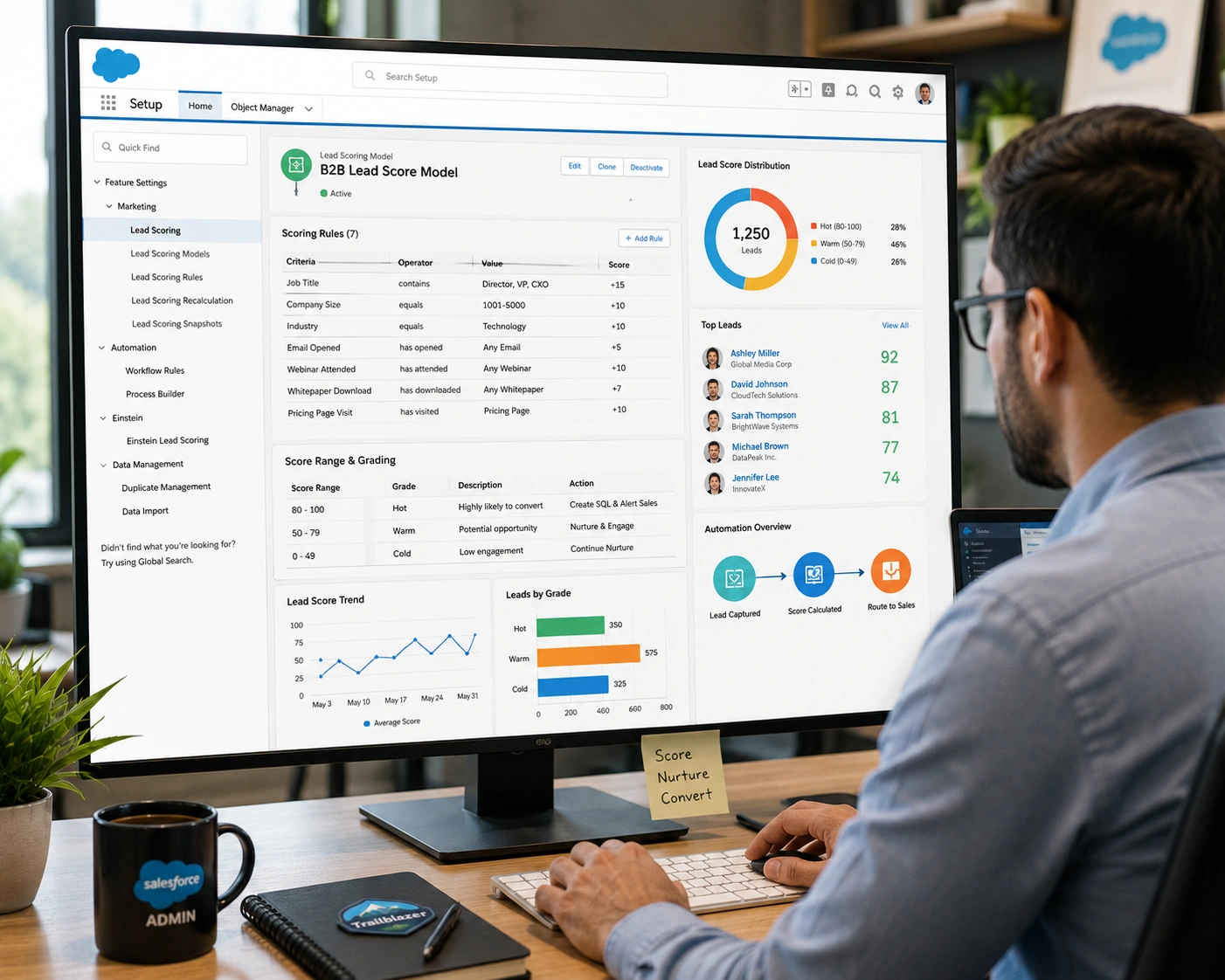
Setting up lead scoring does not need to be overly complicated. The most effective systems are usually simple, practical, and easy to maintain.
Step 1: Define Your Ideal Customer
Start by identifying the characteristics of your best customers.
Review your existing clients and look for patterns such as:
- Industry type
- Business size
- Revenue level
- Service needs
- Decision-maker roles
The goal is to understand which types of leads consistently convert into customers.
Without this step, lead scoring becomes guesswork.
Step 2: Identify High-Value Behaviours
Next, determine which actions indicate strong buying intent.
Common high-value behaviours include:
- Requesting a consultation
- Visiting pricing pages
- Downloading guides
- Watching case studies
- Opening multiple emails
Each behaviour should receive a weighted score based on its importance.
For example:
- Downloading a guide: +10 points
- Visiting pricing page: +20 points
- Booking a consultation: +40 points
This creates a clearer picture of which leads are genuinely engaged.
Step 3: Create Custom Lead Score Fields in Salesforce
Inside Salesforce, create custom fields to track lead scores.
Businesses often separate:
- Demographic score
- Behavioural score
- Total lead score
This structure helps teams understand why leads are scoring highly rather than only seeing a final number.
Organised score fields also improve reporting and automation workflows.
Step 4: Build Automation Rules
Automation is where Salesforce becomes extremely powerful.
Using workflows or automation tools, businesses can automatically update lead scores whenever prospects interact with emails, websites, forms, or campaigns.
Examples include:
- Add points after webinar registration
- Increase score after multiple website visits
- Reduce score after 60 days of inactivity
Automation removes manual work and keeps lead data updated in real time.
Step 5: Set Thresholds for Sales Qualification
Once scoring is active, businesses need clear thresholds for when leads become marketing qualified leads (MQLs) or sales qualified leads (SQLs).
For example:
- 0 to 30 points = Cold lead
- 31 to 60 points = Marketing qualified lead
- 61+ points = Sales qualified lead
These thresholds help sales teams prioritise follow-ups more effectively.
The exact scoring ranges will depend on your business model and sales cycle.
Step 6: Monitor and Optimise Scores
Lead scoring is not a one-time setup. Customer behaviour changes over time, and scoring models should evolve alongside your marketing strategy.
Regularly review:
- Conversion rates
- Campaign performance
- Sales feedback
- Lead quality trends
If certain behaviours no longer predict conversions effectively, adjust the scoring system accordingly.
The businesses that see the best results continuously refine their lead scoring models.
Common Salesforce Lead Scoring Mistakes to Avoid
Even good lead scoring systems can fail if they become too complicated or disconnected from real business outcomes.
Overcomplicating the Scoring System
Many businesses assign too many scoring rules too early. Complex systems often become difficult to manage and confusing for teams.
Start simple and expand gradually.
Ignoring Negative Signals
Businesses sometimes focus only on positive engagement while ignoring warning signs.
Negative scoring is important because it helps filter out poor-quality opportunities.
Failing to Review Scoring Data Regularly
Lead scoring should evolve alongside customer behaviour and market conditions.
A scoring model built two years ago may no longer reflect buying intent accurately in 2026.
Misalignment Between Marketing and Sales
Lead scoring only works when both marketing and sales teams agree on qualification standards.
Without alignment, leads may still be passed to sales too early or too late.
How Lead Scoring Supports Better Lead Nurturing
Lead scoring and lead nurturing work best together.
Once businesses understand which leads are most engaged, they can personalise communication more effectively through automation workflows, segmented campaigns, and targeted follow-ups.
For example:
- High-scoring leads may receive direct sales outreach
- Mid-level leads may enter educational email sequences
- Lower-scoring leads may receive long-term nurturing content
This creates a more strategic lead nurture sydney process where communication matches actual buyer intent.
Instead of sending the same messaging to every contact, businesses can deliver more relevant experiences that gradually build trust and move prospects closer to conversion.
This is especially valuable for service-based businesses with longer decision-making cycles.
Why Sydney Businesses Choose Corient
At Corient, we understand that generating leads is only part of the equation. The real challenge is building systems that consistently convert those leads into revenue.
Many Sydney businesses come to us after investing heavily in advertising or CRM tools without seeing measurable results. Often, the problem is not the platform itself. It is the lack of strategy, automation, and alignment behind it.
We help businesses build:
- Conversion-focused lead generation systems
- CRM implementation strategies
- Marketing automation workflows
- Lead scoring frameworks
- Sales and marketing alignment processes
- Smarter reporting infrastructure
Our approach focuses on creating practical systems that improve visibility, lead quality, and long-term growth.
Whether businesses need better CRM workflows, stronger automation, or more effective lead nurture sydney strategies, we help connect marketing activity with measurable business outcomes.
That is why many Sydney service businesses choose Corient Media Partners as their strategic growth partner rather than simply another marketing vendor. Get in touch with our team today!
Final Thoughts on Salesforce Lead Scoring
Effective salesforce lead scoring helps businesses stop guessing and start prioritising leads more strategically.
By combining demographic information, behavioural data, and automation workflows, businesses can improve conversion rates, reduce wasted sales effort, and create stronger alignment between marketing and sales teams.
The most successful lead scoring systems are not necessarily the most complicated. They are the ones that accurately reflect customer behaviour, support smarter follow-up processes, and evolve over time.
For Australian service businesses looking to improve lead quality and marketing ROI, lead scoring has become an essential part of modern CRM strategy.
Ready to Improve Your Lead Conversion System?
If your business is struggling with inconsistent lead quality, unclear reporting, or disconnected CRM workflows, Corient Media Partners can help you build a smarter growth system.
Learn how we help Sydney businesses improve automation, CRM performance, and lead nurture sydney strategies through scalable marketing systems at Corient.
Check out more articles below:
- AI Marketing Automation in 2026: The Complete Guide for Service Businesses
- How to Use AI to Personalise Email Marketing Campaigns
- 15 ChatGPT Prompts for Marketing Automation That Actually Work
- AI Tools Every Agency Should Use in 2026 to Stay Competitive