Have you ever tried using ChatGPT for your marketing but felt like the results were hit or miss?
We hear this a lot from business owners across Australia. You know AI can save time, but when you sit down to use it, you are not sure what to type. You try a few prompts, tweak the wording, and still end up with something that feels generic or not quite right.
That is exactly where most people get stuck.
The truth is, ChatGPT is only as good as the prompts you give it. When used properly, it can become one of the most powerful tools in your marketing system. That is why we have put together these ChatGPT prompts for marketing automation that actually work in real business scenarios.
If you want to stop guessing and start getting consistent results, this guide will give you practical prompts you can use straight away.
What Are ChatGPT Prompts for Marketing Automation?
ChatGPT prompts for marketing automation are structured instructions you give to AI to generate, manage, or optimise marketing tasks automatically and consistently.
They are used to:
- Create content such as emails and ads
- Automate repetitive marketing tasks
- Improve consistency in messaging
- Save time while maintaining quality
In simple terms, they help you turn AI into a reliable marketing assistant.
What Are the Best ChatGPT Prompts for Marketing Automation?
The best ChatGPT prompts for marketing automation are clear, specific, and designed with a defined goal in mind. Instead of asking vague questions like “write a marketing email,” effective prompts include details about the target audience, tone, purpose, and desired outcome. For example, you can ask ChatGPT to create a follow-up email for a specific type of lead, or generate ad copy tailored to a particular service.
Strong prompts also guide the structure of the response, such as asking for bullet points, step-by-step content, or multiple variations for testing. This makes the output more usable without needing heavy editing. Businesses can use these prompts across different areas like lead generation, email marketing, content creation, and customer engagement. Over time, saving and refining these prompts allows you to build a repeatable system that improves consistency and efficiency. That is why using the right ChatGPT prompts for marketing automation can significantly improve both the quality and speed of your marketing efforts.
Why ChatGPT Prompts Matter in Marketing Automation
For most businesses, time is limited. You cannot afford to spend hours rewriting content or figuring out what works.
Good prompts solve this by:
- Reducing trial and error
- Improving consistency across campaigns
- Speeding up content creation
- Making automation more reliable
In a competitive market like Australia, having efficient systems gives you an edge. It is not just about using AI, but using it properly.
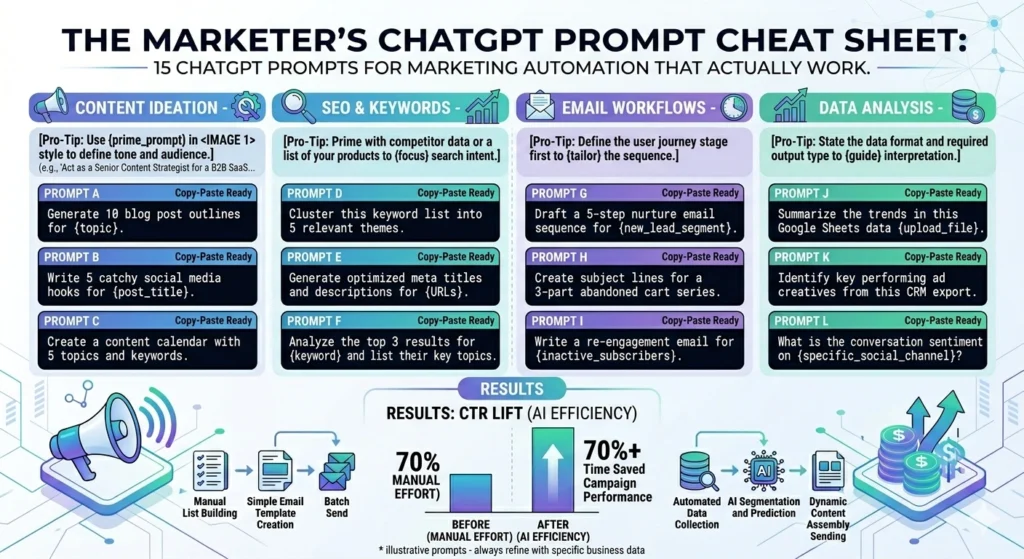
15 ChatGPT Prompts for Marketing Automation That Actually Work
Below are practical, copy-and-paste prompts you can start using today.
Lead Generation Prompts
1. Lead Magnet Idea Prompt
“Act as a marketing strategist. Generate 5 lead magnet ideas for a [type of business] targeting [audience] who want to achieve [goal]. Include a short description for each.”
2. Landing Page Copy Prompt
“Write a high-converting landing page for [service] targeting [audience]. Include headline, benefits, and a strong call to action.”
3. Lead Qualification Prompt
“Create a list of 5 qualifying questions to filter high-quality leads for a [type of service] business.”
Email Marketing Prompts
4. Welcome Email Sequence Prompt
“Write a 3 email welcome sequence for new subscribers of a [business type]. Keep the tone friendly and informative.”
5. Follow-Up Email Prompt
“Write a follow-up email for a lead who showed interest in [service] but has not responded.”
6. Re-Engagement Email Prompt
“Create a re-engagement email for inactive subscribers, encouraging them to reconnect.”
Content Marketing Prompts
7. Blog Outline Prompt
“Create a detailed blog outline for the topic [topic] targeting [audience]. Include headings and key points.”
8. Social Media Content Prompt
“Generate 5 social media post ideas for a [business type] promoting [service].”
9. Content Calendar Prompt
“Create a 2-week content calendar for a [industry] business focusing on engagement and lead generation.”
Ad and Conversion Prompts
10. Ad Copy Prompt
“Write 3 variations of ad copy for [product or service] targeting [audience]. Include different angles.”
11. A B Testing Prompt
“Generate 5 headline variations for testing a campaign promoting [offer].”
12. Call to Action Prompt
“Create 10 call-to-action examples for a [service] encouraging users to book a consultation.”
Customer Journey Prompts
13. Customer Journey Mapping Prompt
“Outline a customer journey for a [business type] from first contact to conversion.”
14. Chatbot Response Prompt
“Write chatbot responses for common enquiries about [service]. Keep them clear and helpful.”
15. Automation Workflow Prompt
“Design a simple marketing automation workflow for a [business type], including lead capture, follow-up, and conversion steps.”
How to Use ChatGPT Prompts Effectively

Step 1: Define your goal
Before you even type a prompt, get clear on what you actually want to achieve.
This is where most people go wrong. They jump straight into ChatGPT without thinking about the outcome, which leads to vague results. Instead, ask yourself:
- Do I want to generate leads?
- Am I writing an email, ad, or blog?
- What action should the reader take?
The clearer your goal, the better your prompt will be. Think of it like briefing a team member. If your instructions are unclear, the output will be too.
Example prompts:
- “Write a lead generation email for a digital marketing agency targeting small business owners in Australia.”
- “Create a blog introduction that encourages readers to book a free consultation for SEO services.”
- “Write a Facebook ad that drives enquiries for a local plumbing business.”
Step 2: Add context
Context is what turns a basic prompt into a powerful one.
Instead of saying “write an email,” include details like:
- Who is your audience?
- What is your service or offer?
- What tone do you want?
- What stage of the journey are they in?
For example, a prompt like “Write a follow-up email for a small business owner in Australia who enquired about digital marketing services” will give you a much better result than something generic.
The more relevant information you provide, the more accurate and useful the response will be.
Example prompts:
- “Write a follow-up email for a small business owner in Australia who enquired about SEO services but has not responded in 3 days.”
- “Create a LinkedIn post for a marketing agency targeting service-based businesses, using a conversational tone and focusing on lead generation.”
- “Write a landing page section for a Facebook ads service targeting tradies who want more leads.”
Step 3: Be specific
Specific prompts remove guesswork and improve consistency.
Tell ChatGPT exactly what you want, including:
- Format such as bullet points, paragraphs, or steps
- Length of the content
- Number of variations
- Style or tone
For example, instead of saying “write ad copy,” you could say:
“Write 3 short ad copy variations for a Facebook campaign targeting local service businesses, focusing on lead generation.”
This level of detail helps you get outputs that are closer to what you need without heavy editing.
Example prompts:
- “Write 5 email subject lines under 10 words for a cold outreach campaign targeting real estate agents.”
- “Create 3 Instagram captions with a casual tone promoting a free marketing audit.”
- “Write a 150-word blog summary in simple English explaining the benefits of Google Ads for small businesses.”
Step 4: Refine the output
Even the best prompts will not always give perfect results on the first try, and that is completely normal.
Think of ChatGPT as a starting point, not the final answer. You can:
- Ask it to rewrite sections
- Adjust tone or clarity
- Expand or shorten content
- Request alternative versions
This process of refining is where the real value comes in. Instead of starting from scratch, you are improving something that is already 70 to 80 percent complete.
Example prompts:
- “Rewrite this email to sound more conversational and less salesy.”
- “Shorten this paragraph to under 100 words while keeping the key message.”
- “Give me 2 alternative versions of this ad with a stronger call to action.”
- “Make this content easier to understand for a beginner audience.”
Step 5: Save your best prompts
Once you find prompts that work, do not lose them.
Create your own prompt library where you store:
- High performing prompts
- Variations for different use cases
- Templates you can reuse
Over time, this becomes one of your most valuable assets. Instead of reinventing the wheel, you can quickly reuse proven prompts and get consistent results every time.
This is how you turn ChatGPT from a one-off tool into a reliable part of your marketing system.
Example prompts to save:
- “You are a direct response copywriter. Write a [format] for a [industry] business targeting [audience] at the [awareness stage] of the buying journey. The tone should be [tone]. The goal is to [desired action]. Include [specific element e.g. a subject line, CTA, or statistic]. Keep it under [word count].”
- “Act as a senior marketing strategist. Write [number] variations of [content type] for a [platform] campaign. The target audience is [audience] in [location]. Each variation should test a different angle: [angle 1], [angle 2], [angle 3]. The primary goal is [goal] and the secondary goal is [goal].”
- “You are writing on behalf of [brand/person]. The brand voice is [adjectives]. The audience is [audience description]. Write a [content type] that addresses the objection ‘[common objection]’ and leads the reader to [desired outcome]. Avoid [specific things to exclude].”
- “Using the PAS framework (Problem, Agitate, Solution), write a [content type] for a [industry] business. The problem is [problem]. The audience is [audience]. The solution is [product/service]. End with a [CTA type] that drives [specific action].”
What Corient Recommends
From our experience, the biggest difference between average and great results comes down to clarity.
We always recommend writing prompts as if you are briefing a real person. The more specific you are, the better the outcome.
We also suggest building your own prompt library. Once you find prompts that work, save them and refine them over time. This turns AI into a consistent part of your workflow rather than a one-off tool.
Most importantly, do not rely on AI alone. Use it to speed things up, but always apply your own judgement. That balance is what makes ChatGPT prompts for marketing automation truly effective.
FAQs
What are ChatGPT prompts for marketing automation?
They are structured instructions used to guide AI in creating and managing marketing tasks.
How do I write better ChatGPT prompts?
Be clear, specific, and include context such as audience and goals.
Can ChatGPT fully automate marketing?
It can support many tasks, but human input is still important.
Are ChatGPT prompts suitable for small businesses?
Yes, they are especially useful for saving time and improving efficiency.
Final Thoughts
AI is changing how marketing works, but tools alone are not enough.
If you want real results, you need systems that are practical and repeatable. That is exactly what these prompts help you build.
Start small, test what works, and refine your approach. Over time, you will create a workflow that saves time and delivers consistent results.
If you want help turning these prompts into a complete marketing system for your business, we are here to guide you.
Book a call with our team and let’s map out a simple, practical approach tailored to your goals.
Check out more articles below:
AI Marketing Automation in 2026: The Complete Guide for Service Businesses
AI Tools Every Agency Should Use in 2026 to Stay Competitive