By Adrian Huber, CEO of Corient, a B2B marketing agency in Sydney. We run Meta for some B2B clients and refuse it for others; this article is the reasoning, with the numbers that drive it.
The most honest sentence written about this channel came from a consultant summarising his intake calls: "Meta ads for B2B are completely useless" is what several traumatised founders told him. The pattern behind the trauma is always the same. Good lead volume at a flattering cost per lead, then sales quietly stops calling the leads, then the platform gets abandoned as a scam.
The uncomfortable truth is that both camps in that argument are right. The founders really did get junk. And the practitioners who reply "I have spent $2 million on B2B Meta profitably" really did. The difference is not luck. It is three specific setup decisions, and every one of them is visible before a dollar gets spent.
Key takeaways
- Yes, Meta works for B2B in a defined role: its CPM runs about $4 against LinkedIn's $25 to $60, so the reach is real and cheap. The question is what you point it at.
- The junk-lead machine is self-inflicted: optimise for form fills and the algorithm dutifully finds the fastest form-fillers on the internet, who are not buyers.
- The cheapest lead is routinely the most expensive outcome: run the arithmetic at the appointment stage, never the form-fill stage.
- The safest first use of Meta in B2B is not cold lead generation at all. It is retargeting the traffic your other channels already paid for.
Are Facebook ads actually good for B2B?
For reach and retargeting, genuinely. For cold lead forms aimed at job titles, mostly no, and that distinction is the whole game.
The case for the platform is arithmetic. Your buyers scroll the same feeds as everyone else, and reaching them costs around $4 per thousand impressions against LinkedIn's $25 to $60. The same human, at a tenth of the price.
Meta earns its place in a B2B budget in a specific order: first as retargeting for visitors your Google, LinkedIn and content work already produced, then as demand generation feeding a nurture system, and only last, if ever, as a cold lead-form channel.
How does Facebook ads B2B targeting actually work?
By behaviour and interest, not by org chart, and that single fact explains most of the platform's B2B reputation. LinkedIn knows job titles; Meta knows humans. What Meta cannot do reliably is know who is a head of procurement, so strategies that need seniority targeting belong on LinkedIn, and pretending otherwise is where most of the trauma starts.
The targeting that does work on Meta for B2B is the kind you bring yourself: retargeting audiences built from your own site traffic and video viewers, lookalikes seeded from your qualified customers rather than your raw lead list, and qualified events fed back from your CRM so the algorithm learns from buyers instead of browsers. Meta is exceptional at finding more of whatever you show it. The discipline is making sure what you show it is a buyer.
Why are my Facebook leads such poor quality?
Because the algorithm is doing exactly what you told it to do. Set the objective to "Leads" with a pre-filled instant form and Meta optimises for people who complete forms with the least friction, which selects for two-tap submitters, not evaluators. The result is the classic audit finding: lead volume up and to the right, and a sales team that has quietly stopped calling.
The fix is measurable, not motivational, and it has three parts.
Optimise for the qualified event, not the form fill. Fire your CRM's qualification event (SQL, meeting booked, ICP match) back into Meta via the Conversions API and make that the optimisation target. The algorithm learns what a buyer looks like instead of what a form-filler looks like. This is not a growth hack; connecting deeper-funnel data is exactly what Meta's own lead ads guidance points to, and in our experience it is the single highest-impact fix available, with quality shifting inside 60 to 90 days.
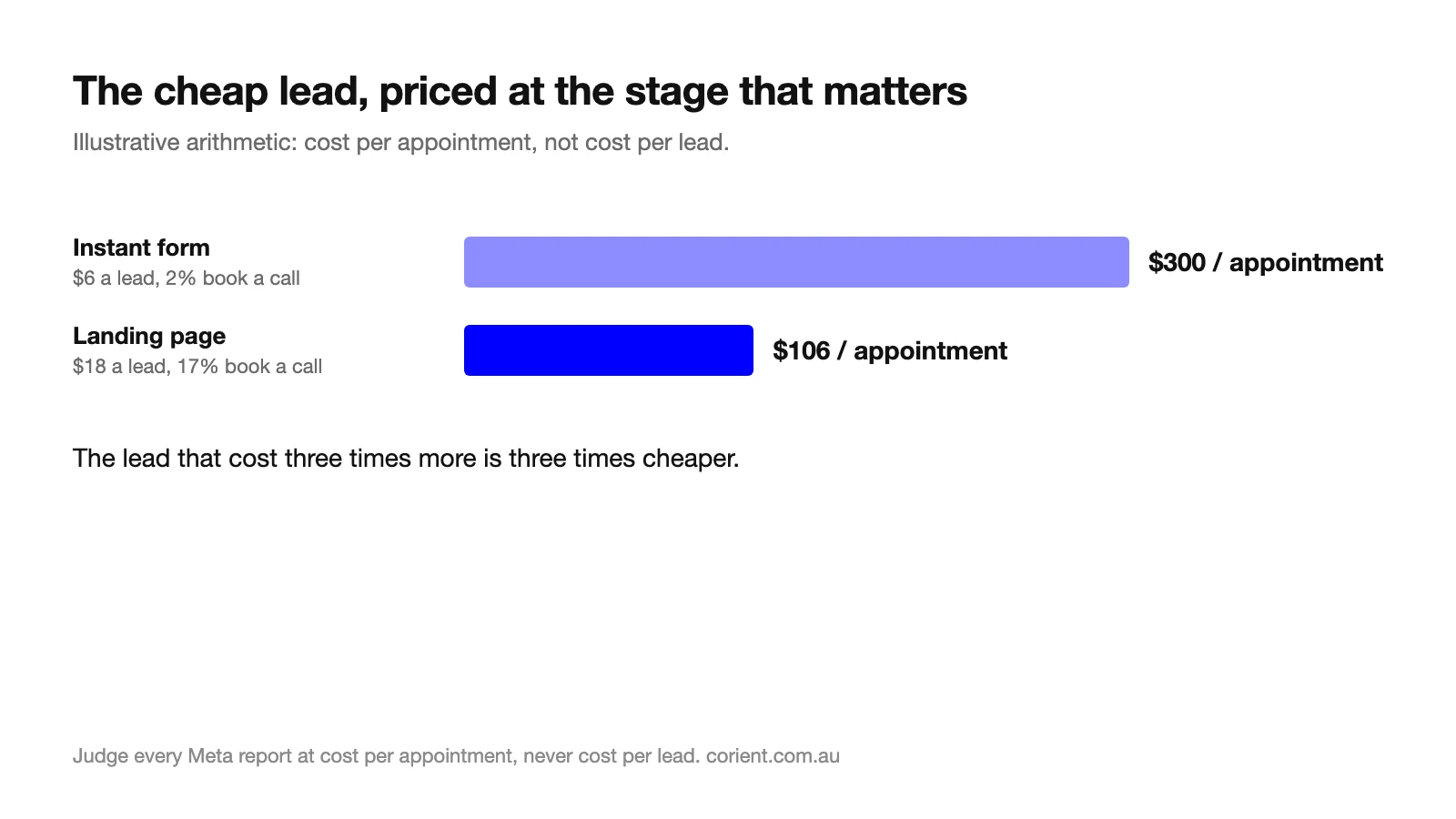
Make the friction do the qualifying. The instant form's pre-fill is the problem, not the feature, and Meta says as much by offering a "higher intent" form type that deliberately adds a review step. Run the arithmetic on an illustrative campaign: instant-form leads at $6 converting to appointments at 2% cost $300 per appointment, while landing-page leads at $18 converting at 17% cost $106. Per appointment, the lead that cost three times more is three times cheaper.
Let the creative reject people. "Free consultation" attracts everyone, including nobody you want. Creative that names the audience and the situation precisely ("for B2B founders spending $50k+ a month on paid") repels the wrong readers, which is the point. In the accounts we see at discovery, the creative is usually the culprit before the tracking is.
What results does the fixed version produce?
The rebuild we recommend runs like this. Replace static images and instant forms with one substantial creative asset that names the problem and shows the mechanism, usually a two-to-four minute video ending in a diagnostic-call ask. Score leads by engagement depth, video watch time being the strongest signal you can create, feed that through the Conversions API, and tier your retargeting by the same signal. Intent signals you create outperform demographics you rent.
One warning that saves campaigns: the first weeks of a rebuild are ugly. Volume drops hard while the algorithm relearns who it is looking for, then recovers against a better baseline over the following month or two. Budget for that trough or you will cancel the fix exactly when it is working.
Set expectations against an independent yardstick too. One founder ran $20,000 of Facebook ads against $20,000 of cold email on the same offer: Facebook won on raw meetings, and after show rates and qualification the cost per qualified call was $391 against $389, a dead heat, with Facebook's number still excluding the agency retainer and creative production. Meta at its best is a strong channel, not a cheat code.
What should a Sydney B2B budget actually run on Meta?
Retargeting first, always. Website visitors, video viewers, pricing-page readers: these audiences already met you on someone else's budget, and Meta reaches them for a fraction of what LinkedIn charges. Tier the follow-up by recency and depth, direct offers inside two weeks, proof and objection content after that. Excluding people who watched only a few seconds of your video is a one-afternoon change that routinely cuts retargeting waste.
Then demand generation into a nurture system, if the economics support it. Content that makes the problem legible, feeding the retargeting pool and a sequence that does the conversion work over months. What that sequence should look like is its own article: the nurture sequence B2B buyers respond to.
On budget, the floor in this market is roughly $3,000 a month in media. Below that, B2B lead costs produce too few conversions for the algorithm to exit learning or for you to read the result, and the platform's appetite for fresh creative every four to six weeks goes unfunded, so the campaign decays while you wait for significance. If $3,000 is not available, spend it on conversion rate and use Meta purely as cheap retargeting, which works at almost any budget.
The boundary case from our own work: FixZa's Meta campaign produced 100 leads in 30 days, and it deserves the asterisk we always attach. That was homeowners making a low-consideration decision alone, every condition Meta loves. For Forward Funding, a considered financial product, Meta worked as one instrumented channel beside a cold email programme, judged on cost per qualified application, never on lead count. Same platform, different job, and knowing which job you are hiring it for is the entire discipline. For the LinkedIn comparison in full, see LinkedIn Ads versus Meta Ads for B2B.
How do you know when to stop?
Three signals inside six weeks, none of which is "CPL went up".
Lead quality flat while spend rises: the audience is too small or too vague to optimise against, a chronic Sydney problem once you stack industry and geography filters, and widening to national reach or optimising on a more frequent event fixes it more often than more money does. Sales quietly not calling the leads: check contact attempts in the CRM rather than asking, because nobody volunteers this in a meeting and it is the truest quality report in the company. And attribution that cannot isolate Meta's contribution: without it you are not running a test, and no budget increase turns a vibe into an answer.
Frequently asked questions
Do Facebook ads work for B2B in Australia?
Yes, in a specific role: retargeting and demand generation aimed at qualified-event optimisation, where Meta's roughly $4 CPM buys reach LinkedIn charges six to fifteen times more for. Cold instant-form campaigns optimised on raw leads produce the junk that gives the platform its B2B reputation.
What is a good cost per lead for Facebook B2B ads?
The wrong question, and the reason most Meta budgets die. Current benchmark data puts Meta leads at roughly $25 to $60 against LinkedIn's $75 to $150, but a cheap lead converting at 2% costs more per appointment than an expensive one converting at 17%. Judge cost per appointment or per sales-qualified lead, never cost per form fill.
How do I improve Facebook lead quality for B2B?
Feed your CRM's qualified-lead event back through the Conversions API and optimise on that instead of form fills, replace pre-filled instant forms with a landing page or Meta's higher-intent form type, and write creative that names the intended reader precisely enough to repel everyone else. Expect a two-to-three week performance dip while the algorithm relearns, then a better baseline.
Should I use Meta or LinkedIn for B2B ads?
LinkedIn when the buyer is defined by job title and the deal size carries its $75 to $150 lead costs; Meta when the audience is definable by behaviour, and always for retargeting, where it is the cheapest professional reach available. The strongest pattern runs both: LinkedIn and Google create the visit, Meta stays present through the 121-day consideration cycle.
What budget do Meta ads need for B2B in Sydney?
About $3,000 a month in media as a testing floor, plus creative refreshed every four to six weeks. Below the floor, run retargeting only, which stays effective at small budgets because the audience is already warm and finite.
Why did my Meta ads work for a month and then die?
Usually creative fatigue rather than audience death: Meta consumes creative faster than any channel, and a campaign still running launch assets in month three is in managed decline. The second suspect is a small audience that never let the campaign exit learning, which shows as costs drifting up while results get erratic.
Are Facebook instant forms or landing pages better for B2B?
Instant forms for low-commitment offers where volume is the goal and qualification happens downstream; landing pages or higher-intent forms for anything sales will call, because the friction is the filter. If speed matters more than either: leads contacted within five minutes convert dramatically better, and Meta leads cool faster than search leads because nobody was searching for you.
Corient runs paid acquisition for founder-led businesses in Sydney, and tells clients when Meta is the wrong tool. For a straight read on your mix, book a call or see our work.