By Adrian Huber, CEO of Corient, a B2B marketing agency in Sydney. Every number here is linked and dated, so you can budget from this page without trusting the author.
Search "average cost per lead b2b" and you will find figures ranging from a few dollars for an email-driven lead to $784 for a paid legal lead, most of them contradicting each other, some recycled from surveys nearly a decade old and republished as current data. The numbers are not wrong. They are answering different questions, and nobody tells you which question their table answers.
So here is the whole thing untangled: what a lead costs on each channel, why the "benchmark" articles disagree by a factor of ten, and the one calculation that makes every other number in this article make sense.
Key takeaways
- A platform lead (a form fill inside an ad account) and a blended qualified lead (all marketing cost divided by sales-ready leads) differ by 3 to 8 times. Both get called "cost per lead".
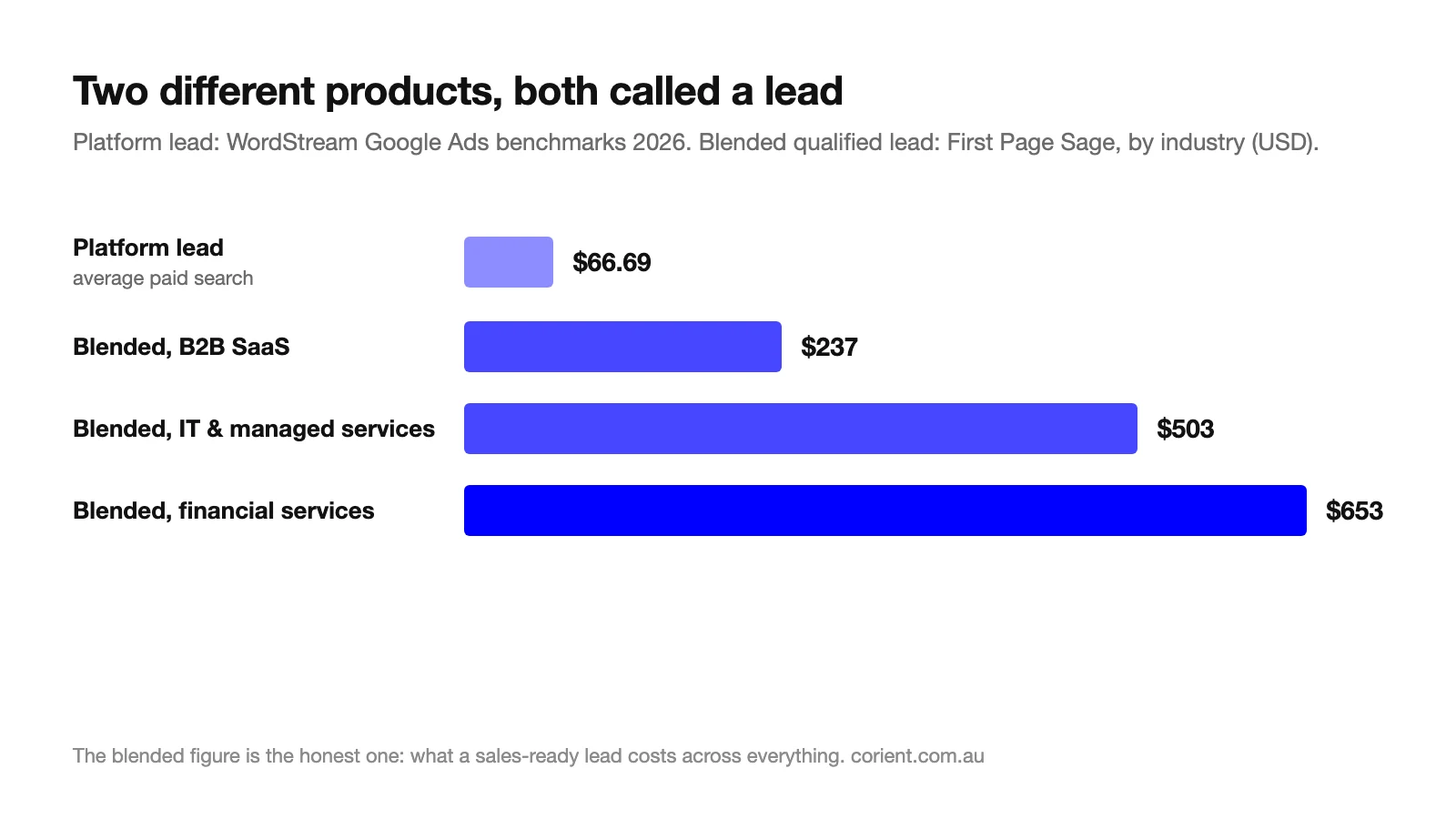
- Current large-sample data: paid-search leads average $66.69 across more than 13,000 US campaigns, while blended B2B leads run $237 to $653 depending on industry.
- Cheap leads routinely cost more per opportunity than expensive ones. A $60 lead converting at 12% beats a $310 lead converting at 2% by a factor of thirty.
- In Australia, meaningful agency-run lead generation starts around $3,500 a month all-in, and the quoted retainer is typically 40 to 65% of what you will actually spend.
Why does every cost-per-lead benchmark contradict the others?
Because "lead" is not a standardised unit, and the two big data sources are measuring different products.
WordStream's 2026 benchmarks, drawn from more than 13,000 search advertising campaigns, put the average paid-search lead at $66.69. That is the cost of a raw hand-raise: any form fill, call or chat the ad platform tracked, before anyone checks whether the person is qualified, reachable, or real.
First Page Sage's cross-channel report measures gross marketing cost per lead: content, SEO, agency fees and media combined. On that measure, B2B SaaS runs $237 blended ($310 paid, $164 organic), IT and managed services $503, financial services $653.
Same word, different product. The same legal enquiry can read as under $150 in the platform dataset and $649 in the blended one, and both are right. There is also a third trap worth knowing: a chunk of the CPL figures circulating in 2026 articles trace back to a single industry survey from the late 2010s, republished for years without disclosure. Before you benchmark against any number, ask what year the data is from, what counted as a lead, and whose campaigns produced it. A vendor quoting a single "industry standard" figure without those three answers is guessing.
What does a B2B lead cost by channel?
Using current, named-source figures rather than folklore: on the platform measure, Meta leads run roughly $25 to $60 and LinkedIn $75 to $150, with paid search averaging $66.69. Email is close to free per send for a list you already own. On the blended measure, a qualified B2B lead runs $237 to $653 depending on industry once every marketing cost is counted.
Two readings to resist. First, "email is basically free" is only true for a list you already own; it is a reactivation channel, not an acquisition one. Second, "Meta is the cheapest acquisition channel" is exactly the trap the next section is about.
Why do cheap leads end up costing the most?
Because the number that decides your economics is cost per opportunity, and conversion rates vary far more than lead prices do.
Run the arithmetic yourself and it turns brutal. A nurtured $60 content-syndication lead converting to opportunity at 12% costs $500 per opportunity. A $310 paid-search lead, First Page Sage's paid average for B2B SaaS, converting at around 2% costs $15,500 per opportunity. The lead that looked five times cheaper is thirty times more expensive at the stage that matters.
The same trap in miniature sits inside Meta's own lead formats. Pre-filled instant forms minimise friction, which is why they produce more leads at a lower cost and a lower intent, and Meta's own Business Help Centre offers a "higher intent" form variant for exactly this reason. Price it at the appointment stage with illustrative numbers: $6 instant-form leads booking at 2% cost $300 per appointment, while $18 landing-page leads booking at 17% cost $106. The three-times-more-expensive lead is three times cheaper.
So here is the weapon to take into any agency conversation: ask for cost per qualified opportunity, not cost per lead. Divide any CPL by the rate at which those leads become real sales conversations. An agency that cannot produce that second number is not measuring far enough down the funnel to be accountable for anything you care about. And when you calculate your own, count everything: media, fees, creative, tools and the loaded time of whoever runs it. Companies that count full costs report CPL figures 35 to 60% higher than the ad-spend-only version, which means most published "great results" are flattered by a third.
What does lead generation cost in Australia specifically?
Across the proposals and rate cards we see in the Australian market, agency fees run roughly $2,500 to $40,000 a month, with $3,500 to $10,000 the realistic band for a founder-led business buying genuine depth. The loaded commitment, adding media, creative and tooling, typically reaches 1.5 to 2.5 times the retainer. Price a $6,000 retainer as a $9,000 to $15,000 monthly decision or you will be underfunded by month three, which is exactly when a channel test needs budget to reach a verdict. The full band-by-band picture, including the four costs that sit outside every quote, is in what digital marketing costs in Sydney.
Four pricing models exist here, and each moves risk somewhere different. A flat retainer puts delivery risk on the agency and is the cleanest default. Pass-through adds convenience and a conflict: insist on seeing platform invoices. Percentage of spend, usually 10 to 20%, aligns the agency with spending more rather than spending well. And pay-per-lead, the model that looks safest, is usually the most expensive per opportunity, because the agency prices in its risk and optimises for the volume that the arithmetic above just discredited.
How do you buy lead generation without getting burned?
Structure, not promises. The pattern in every burned-founder thread is the same trio: no named accountable person, no defined outcome, and metrics that stop at the form fill.
Demand the funnel be measurable before the spend starts. For Forward Funding we stood up two channels at once, a targeted Meta campaign generating inbound applications from qualified borrowers alongside a cold email programme reaching thousands of prospects. Running two channels simultaneously is usually a mistake, and it was the right call there for one reason only: the pipeline was instrumented from day one, so each channel's cost per qualified opportunity was readable separately. Without that, two channels is just two experiments whose results you cannot tell apart, paid for twice.
Agree the kill threshold in writing. A named channel, a test budget above the significance floor, and the number that ends the test either way. An agency that will not name the failure condition is planning to be judged on narrative.
Ask where account management is funded from. Most retainers pay for strategy calls, reporting and project management out of the same pool as delivery, which is why delivery quietly shrinks in busy months. We scope retainers as capability lanes with management carried on top, not inside, and our tiers are lane counts (Launch two, Momentum three, Partner four). Whoever you hire, make them answer that question in one sentence.
The wider argument for quality over volume, with the sales-time maths, is in the real cost of bad leads.
Frequently asked questions
What is the average cost per lead for B2B?
A raw paid-search form fill averages $66.69 across more than 13,000 campaigns in WordStream's 2026 data, while a blended qualified B2B lead runs $237 to $653 depending on industry, with B2B SaaS at the low end of that range. Any single "average" that does not say which of those two things it is measuring is not usable.
What is a good cost per lead benchmark for B2B SaaS?
Around $237 blended, or $310 on paid channels alone, per First Page Sage's cost-per-lead report. But judge it against cost per opportunity: a higher CPL with a strong lead-to-opportunity rate regularly beats a cheap CPL converting at 2%.
How is cost per lead calculated?
Total campaign spend divided by leads generated in the same period, and the honest version includes media, agency fees, creative production, tools and the loaded time of whoever manages it. Then divide that CPL by your lead-to-opportunity rate, because cost per opportunity is the number that predicts whether the channel can ever pay for itself.
How much does B2B lead generation cost per month in Australia?
Agency fees of $2,500 to $40,000 a month across the market, with $3,500 to $10,000 the working band for a founder-led business, and a fully loaded commitment of roughly 1.5 to 2.5 times the retainer once media, creative and tooling are counted.
Is pay per lead better than a retainer?
Usually not for considered B2B purchases. Pay-per-lead pricing embeds the provider's risk premium and points their incentive at volume, precisely the metric this article shows is misleading. A flat retainer with a written kill threshold and cost-per-opportunity reporting keeps the incentives closer to yours.
Why are my leads cheap but nothing closes?
Because the channel or the offer is selecting for people who fill in forms easily rather than people with the problem and the budget. Check the lead-to-opportunity rate by source: anything converting under about 5% is volume theatre, and your sales team's quiet refusal to call a source is usually the most accurate quality report you own.
What should a lead generation proposal include?
The channel to be tested first, the budget and why it clears significance, the definition of a qualified lead agreed with sales, the kill threshold, who owns which capability by name, where account management is funded from, and reporting that shows cost per qualified opportunity rather than cost per form fill.
Corient builds measurable acquisition systems for founder-led businesses in Sydney. If you want your own numbers run through the cost-per-opportunity arithmetic, book a call or see what we have built.