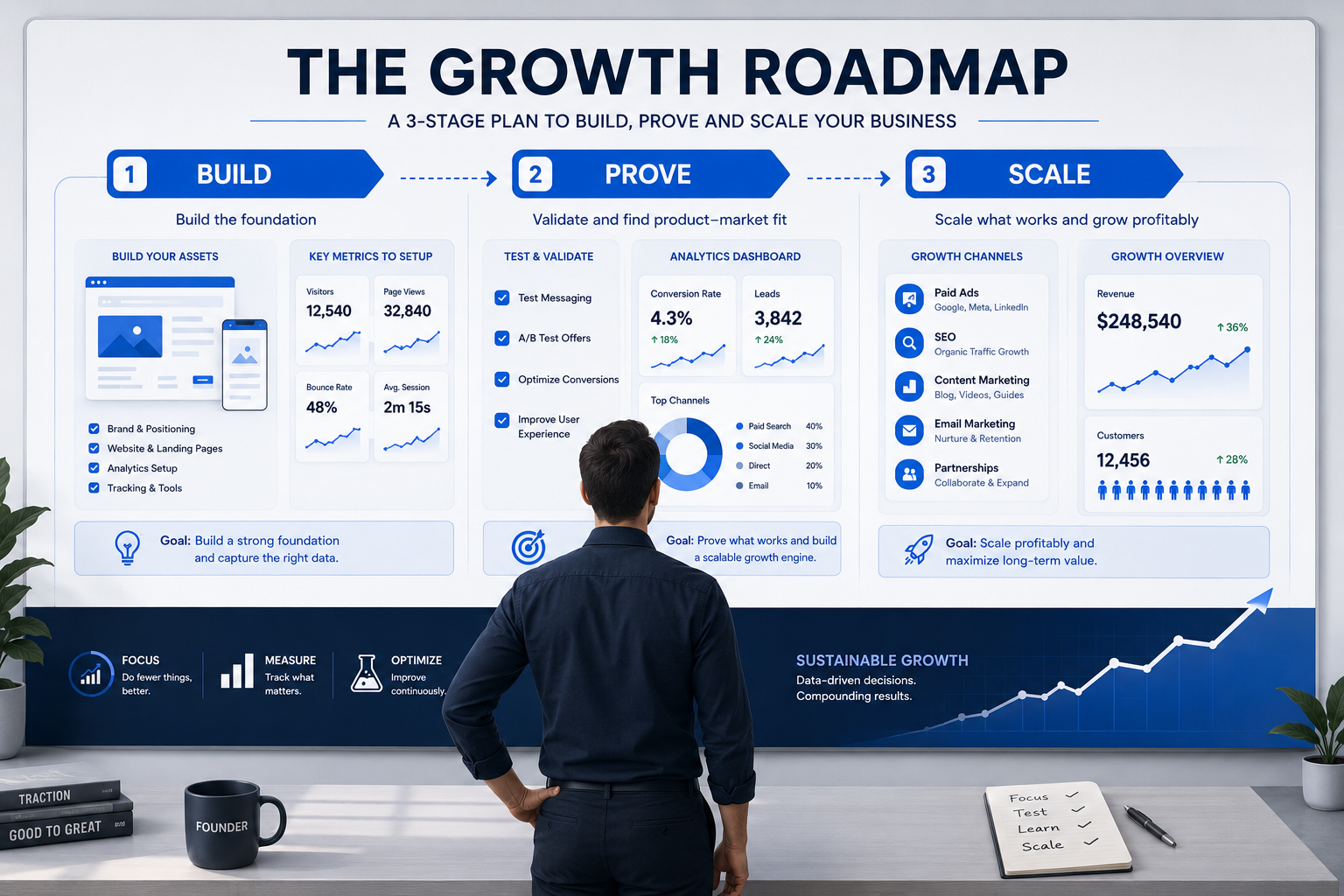
Every founder wants to grow faster. After landing your first customers or seeing early traction, it's tempting to launch more campaigns, increase your marketing budget, or expand into every acquisition channel available. It feels like the fastest path to growth.
In reality, trying to grow everywhere at once often slows you down. Every new marketing channel demands time, budget, creative resources, reporting, and ongoing optimisation. Instead of building momentum, founder-led startups frequently spread themselves too thin, making it difficult to identify what's actually driving qualified pipeline and revenue.
The startups that scale successfully take a different approach. They master one acquisition channel, prove it delivers consistent results, and only then expand into the next opportunity.
In this article, you'll learn:
- Why focusing on one marketing channel leads to faster, more predictable growth
- How to choose the best acquisition channel for your startup
- What it means to "prove" a channel before investing more
- The signs you're ready to expand into a second marketing channel
- How Corient's Build → Prove → Scale Method™ helps startups grow without spreading resources too thin
Why Most Startups Add Too Many Marketing Channels Too Soon
Every founder wants growth.
When early traction begins to slow, adding another marketing channel often feels like the obvious solution.
Unfortunately, more channels rarely solve the underlying problem.
Instead, they often introduce unnecessary complexity before the business has proven what already works.
The Pressure to "Be Everywhere"
Modern marketers have more opportunities than ever before.
A founder might feel pressure to invest in:
- Google Ads
- LinkedIn Ads
- Search Engine Optimisation (SEO)
- Email marketing
- Content marketing
- YouTube
- Podcasts
- Webinars
- Partnerships
- Organic social media
Each platform promises access to new customers and greater visibility.
The challenge isn't that these channels are ineffective. It's that very few startups have the resources to execute all of them well at the same time.
For founder-led businesses with limited budgets and lean teams, trying to manage every opportunity usually leads to inconsistent execution.
Instead of building expertise in one acquisition channel, the team ends up making incremental progress across many.
How Marketing Complexity Grows Faster Than Results
Adding a new marketing channel isn't simply a matter of publishing more content or launching another advertising campaign.
Each channel requires its own strategy, creative assets, reporting, optimisation process, and performance analysis.
For example, launching LinkedIn advertising means creating audience segments, writing ad copy, designing creative assets, building landing pages, tracking conversions, and monitoring campaign performance.
SEO requires keyword research, technical optimisation, content creation, internal linking, and ongoing updates.
Email marketing involves customer segmentation, automation workflows, copywriting, and lifecycle campaigns.
As more channels are introduced, complexity grows exponentially.
Without strong systems in place, founders spend more time managing marketing than improving it.
The result is fragmented execution, inconsistent messaging, and slower decision-making.
The Real Cost of Divided Attention
When resources are spread across too many channels, performance often suffers in ways that aren't immediately obvious.
Marketing budgets become diluted, making it difficult for any single channel to generate meaningful results.
Teams constantly switch between priorities instead of refining one proven process.
Reporting becomes increasingly difficult as data is scattered across multiple platforms, reducing confidence in future investment decisions.
Perhaps most importantly, customer acquisition becomes unpredictable.
Instead of building a reliable growth engine, startups find themselves relying on isolated campaign successes that are difficult to repeat.
This is why many founder-led startups feel busy without making measurable progress.
Marketing activity increases, but business outcomes remain inconsistent.
Why Mastering One Channel Creates Better Growth
Successful startups understand that sustainable growth comes from focus.
Rather than asking, "Which channel should we add next?", they first ask, "Which channel deserves our full attention?"
By committing to one acquisition channel, founders create an environment where continuous improvement becomes possible.
Deeper Customer Insights
Concentrating on a single marketing channel provides clearer visibility into customer behaviour.
Instead of trying to interpret data from multiple sources, founders can develop a deeper understanding of:
- Which messages resonate with their audience
- What motivates prospects to convert
- Which content generates qualified leads
- Where customers leave the buying journey
These insights become increasingly valuable over time because they are based on consistent patterns rather than scattered observations.
Understanding customer behaviour at this level allows startups to make more informed decisions about messaging, offers, and future marketing investment.
Better Conversion Optimisation
Marketing success isn't determined solely by the number of people who visit your website.
It's determined by how effectively those visitors become customers.
Focusing on one acquisition channel gives startups the opportunity to continuously improve every stage of the customer journey.
Rather than constantly launching new campaigns, teams can optimise existing ones by testing:
- Headlines
- Calls to action
- Landing pages
- Lead forms
- Page layouts
- Value propositions
- Customer messaging
Even small improvements in conversion rates can significantly increase marketing performance without increasing advertising spend.
For founder-led startups operating with limited resources, optimisation often delivers a higher return than expansion.
Lower Customer Acquisition Cost (CAC)
One of the biggest advantages of mastering a single marketing channel is the opportunity to reduce Customer Acquisition Cost (CAC).
As campaigns become more refined, founders gain a better understanding of which audiences convert, which messaging performs best, and where marketing spend delivers the strongest return.
Instead of paying to learn the same lessons across multiple channels, every optimisation contributes to improving one proven system.
Over time, this creates more efficient customer acquisition and provides greater confidence when additional investment is required.
How to Choose the Right First Marketing Channel
Marketing Channels Compared
Choose the right channels to attract your ideal audience and drive growth

Many startups fail because they try to launch SEO, Google Ads, LinkedIn, email marketing, webinars, PR, and partnerships all at once. The result is fragmented execution, limited insights, and no clear understanding of what's actually driving growth.
A better approach is to choose one channel that best matches your business, your customers, and your available resources.
Here are the factors to consider.
Know Where Your Customers Spend Their Time
Your first marketing channel should align with where your ideal customers already look for information.
For example:
- B2B SaaS founders often research solutions through Google Search and LinkedIn.
- Technical buyers frequently consume educational content before booking demos.
- Product-led companies may benefit from SEO because buyers actively search for solutions to specific problems.
Instead of asking, "Which channel is trending?", ask:
- Where do our customers start their research?
- What questions do they ask before buying?
- Which platform influences their decision?
The answers should guide your channel selection.
Match the Channel to Your Sales Cycle
Different channels work better for different buying journeys.
For startups with longer sales cycles, educational channels often outperform interruptive advertising because buyers spend more time evaluating options.
For example:
SEO and Content Marketing
Works well when customers actively search for answers before making a purchasing decision.
Ideal for founder-led thought leadership and relationship building.
Paid Search
Useful when prospects already know the problem they need to solve.
Email Marketing
Best used after leads have entered your pipeline.
Choosing the wrong channel isn't always disastrous; it simply makes customer acquisition more expensive than it needs to be.
Consider Your Resources
Every marketing channel requires different investments.
SEO requires:
- Content production
- Technical optimisation
- Patience
- Consistency
Paid advertising requires:
- Budget
- Creative assets
- Landing pages
- Ongoing optimisation
LinkedIn thought leadership requires:
- Founder involvement
- Consistent publishing
- Audience engagement
Don't choose a channel because another startup succeeded with it.
Choose the one your team can execute consistently.
Consistency almost always beats variety.
What Success Looks Like Before Expanding
The biggest mistake founders make is assuming that a few good results mean a channel is ready to scale.
Instead, look for repeatable evidence.
A channel is proving itself when you can consistently answer questions like:
- Are we generating qualified leads every month?
- Is our Customer Acquisition Cost (CAC) stable?
- Are conversion rates improving?
- Do we understand why customers convert?
- Can we forecast future performance?
If these answers are yes, you've built confidence.
Confidence, not optimism, is what justifies expansion.
Measure Business Outcomes, Not Marketing Activity
Many teams celebrate metrics that look impressive but don't support business growth.
Examples include:
- Website traffic
- Social media followers
- Video views
- Impressions
- Clicks
These numbers are useful, but they don't necessarily indicate commercial success.
Instead, monitor metrics that affect revenue.
Examples include:
- Qualified leads
- Sales opportunities
- Pipeline value
- Customer Acquisition Cost (CAC)
- Customer Lifetime Value (LTV)
- Return on Marketing Investment (ROMI)
- Revenue influenced by marketing
These metrics tell you whether your marketing system is actually working.
Build Repeatable Processes
Success shouldn't depend on one campaign or one employee.
As your first channel matures, document:
- Messaging
- Campaign structure
- Landing pages
- Reporting
- Lead qualification
- Optimisation process
Documented systems make future scaling faster and significantly less risky.
Instead of starting from scratch every time, your team builds on proven processes.
When It's Time to Add a Second Channel
Adding another marketing channel isn't about chasing more opportunities.
It's about increasing predictable growth.
Consider expanding only when:
- One acquisition channel consistently generates qualified leads.
- Conversion rates remain stable.
- Reporting clearly identifies where revenue comes from.
- Customer Acquisition Cost is profitable.
- Your team can manage another channel without reducing performance.
When these conditions exist, adding another channel becomes a calculated investment rather than a gamble.
For example:
A startup that has proven SEO may add LinkedIn thought leadership.
A company succeeding with Google Ads may expand into lifecycle email marketing.
Each new channel strengthens the existing system rather than competing with it.
Growth compounds because every new investment builds on an already successful foundation.
How Corient Helps Startups Scale One Channel at a Time
Most founder-led startups don't need more marketing channels; they need one channel that consistently generates a qualified pipeline.
That's the philosophy behind The Corient System™.
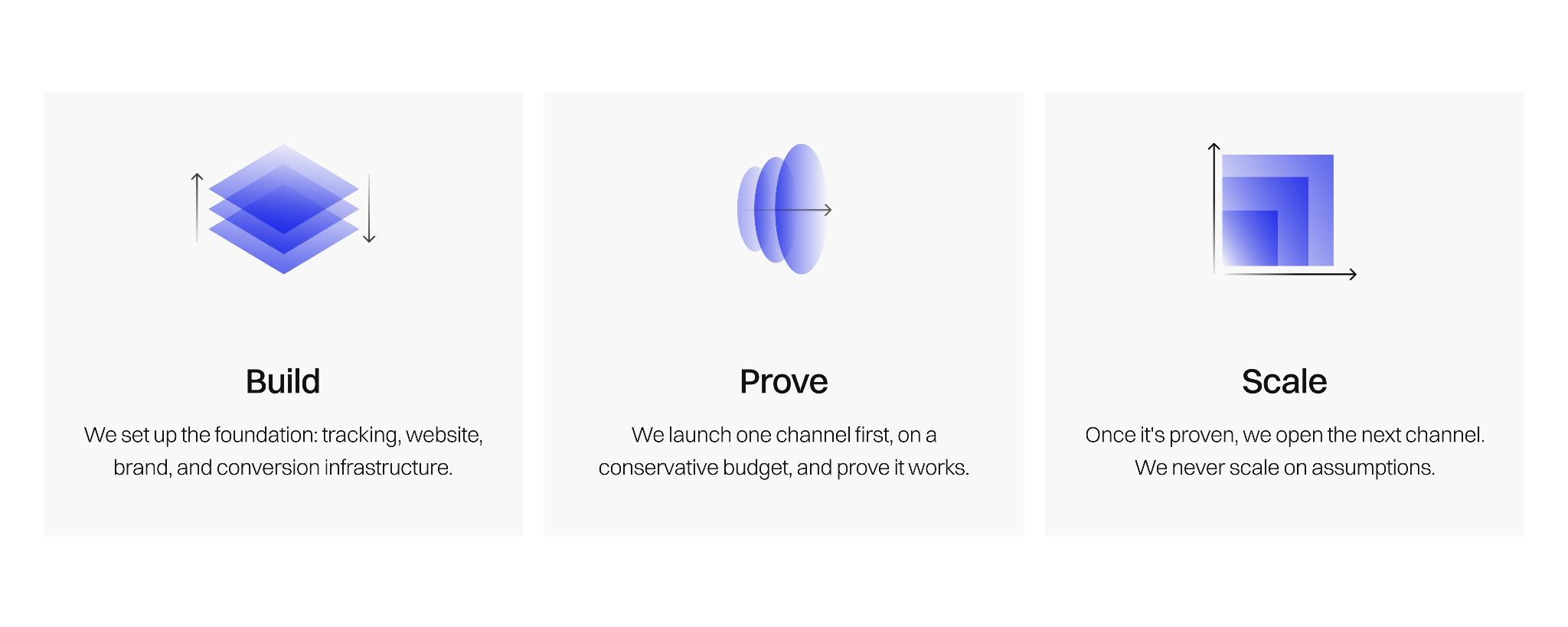
Instead of launching multiple campaigns across different platforms, Corient helps startups identify the acquisition channel with the greatest potential, prove it works through measurable performance, and only then expand into additional channels.
The framework follows three stages.
Build
Before investing heavily in customer acquisition, Corient helps startups build the foundations required for sustainable growth.
This includes:
- Defining the Ideal Customer Profile (ICP)
- Clarifying positioning and messaging
- Creating a conversion-focused website
- Setting up analytics and attribution
- Establishing reporting dashboards
- Mapping the customer journey
Rather than rushing into campaigns, startups create the infrastructure that supports every future marketing investment.
Prove
Once the foundation is in place, Corient focuses on validating a single acquisition channel.
This could be:
- Organic search (SEO)
- Google Ads
- Content marketing
- Lifecycle email marketing
The objective isn't to generate a short-term spike in leads. It's to prove that the channel can consistently deliver a qualified pipeline.
During this phase, Corient tracks metrics such as:
- Customer Acquisition Cost (CAC)
- Conversion rates
- Marketing Qualified Leads (MQLs)
- Sales Qualified Leads (SQLs)
- Pipeline value
- Return on Marketing Investment (ROMI)
Only when performance becomes predictable does Corient recommend increasing investment.
Scale
Scaling happens after the evidence exists, not before.
Once a channel has demonstrated consistent performance, startups can confidently:
- Increase advertising budgets
- Publish more SEO content
- Expand into LinkedIn thought leadership
- Launch lifecycle email campaigns
- Introduce marketing automation
- Add complementary acquisition channels
Because every decision is based on proven results, growth becomes more predictable, efficient, and sustainable.
This is the difference between building a marketing engine and simply running more campaigns.
Common Mistakes When Expanding Marketing Channels
Many startups assume more channels automatically mean more growth.
In reality, expanding too early often creates more complexity than revenue.
Here are some of the most common mistakes.
Scaling Before Measuring
Increasing budgets without understanding performance usually leads to wasted spend.
If you don't know why a campaign succeeded, you can't reliably repeat it.
Adding Channels to Solve Conversion Problems
A new channel won't fix:
- Weak positioning
- Poor messaging
- Low-converting landing pages
- Broken customer journeys
More traffic simply exposes these weaknesses faster.
Copying Competitors
Just because another startup is investing in podcasts, TikTok, or LinkedIn Ads doesn't mean those channels are right for your business.
Your strategy should be based on your customers, not someone else's marketing mix.
Ignoring Attribution
If you can't identify which channel generated revenue, adding more channels only makes reporting more confusing.
Strong attribution should come before expansion.
Trying to Manage Everything Internally
As more channels are introduced, execution becomes increasingly difficult.
Without documented systems, automation, and clear ownership, marketing complexity grows faster than results.
Successful startups scale systems, not chaos.
Frequently Asked Questions
Should startups only use one marketing channel?
No. Most successful startups eventually use multiple channels.
The key is proving one channel first before expanding into others.
Which marketing channel should startups start with?
It depends on your audience, sales cycle, and product.
For many B2B technology companies, SEO, content marketing, LinkedIn, or Google Ads are strong starting points because they align with how buyers research solutions.
How do I know when a channel is working?
Look beyond traffic and engagement.
A channel is working when it consistently generates:
- Qualified leads
- Sales opportunities
- Profitable Customer Acquisition Cost (CAC)
- Pipeline growth
- Revenue
Repeatable business outcomes matter more than isolated campaign wins.
How long should startups test one channel?
There's no universal timeframe.
Instead of focusing on time, focus on evidence.
Continue testing until you have enough reliable data to determine whether performance is repeatable and commercially viable.
Final Thoughts
Many startups struggle with marketing not because they lack ambition, but because they try to scale too many channels before proving any of them truly work.
Sustainable growth comes from discipline.
Identify the channel that best matches your customers, execute it consistently, measure the outcomes, and optimise until performance becomes predictable. Only then should you expand into additional channels.
This approach reduces wasted spend, improves decision-making, and creates a marketing system that grows stronger over time.
At Corient, we help founder-led startups replace guesswork with evidence. Through our Build → Prove → Scale methodology, we help businesses validate one acquisition channel, build repeatable systems, and scale confidently with measurable results.
Ready to build a marketing system that delivers predictable growth? Contact Corient to learn how The Corient System™ can help you prove what works before you scale.
Check out more articles below:
- Founder-Led Marketing: Why Startups Need a Marketing System Instead of Just More Campaigns
- Why Most Startup Marketing Strategies Fail Before They Ever Scale
- What Is a Marketing Operating System? Why Founder-Led Tech Startups Are Moving Beyond Traditional Marketing Agencies
- 10 Signs Your Startup Isn't Ready to Scale Marketing Yet