Launching a startup is exciting, but the first 90 days of marketing often determine whether growth becomes predictable or remains a constant struggle.
Many founders believe success comes from doing more—running paid ads, posting on every social platform, publishing blog content, and testing every new marketing trend.
While these activities can create early momentum, they rarely build a marketing system that delivers consistent, long-term results.
The most successful startups take a different approach.
Instead of trying to be everywhere at once, they focus on building strong marketing foundations, validating what works, and using data to guide every decision.
This approach reduces wasted marketing spend, improves customer acquisition, and creates a repeatable growth engine that can scale with confidence.
In this guide, you'll learn how to build a sustainable marketing foundation during your first 90 days, including:
- What to focus on in the first month to build the right marketing foundations
- How to validate your positioning, messaging, and acquisition channels before scaling
- Which metrics to track to measure meaningful progress
- Common mistakes that slow early-stage growth and how to avoid them
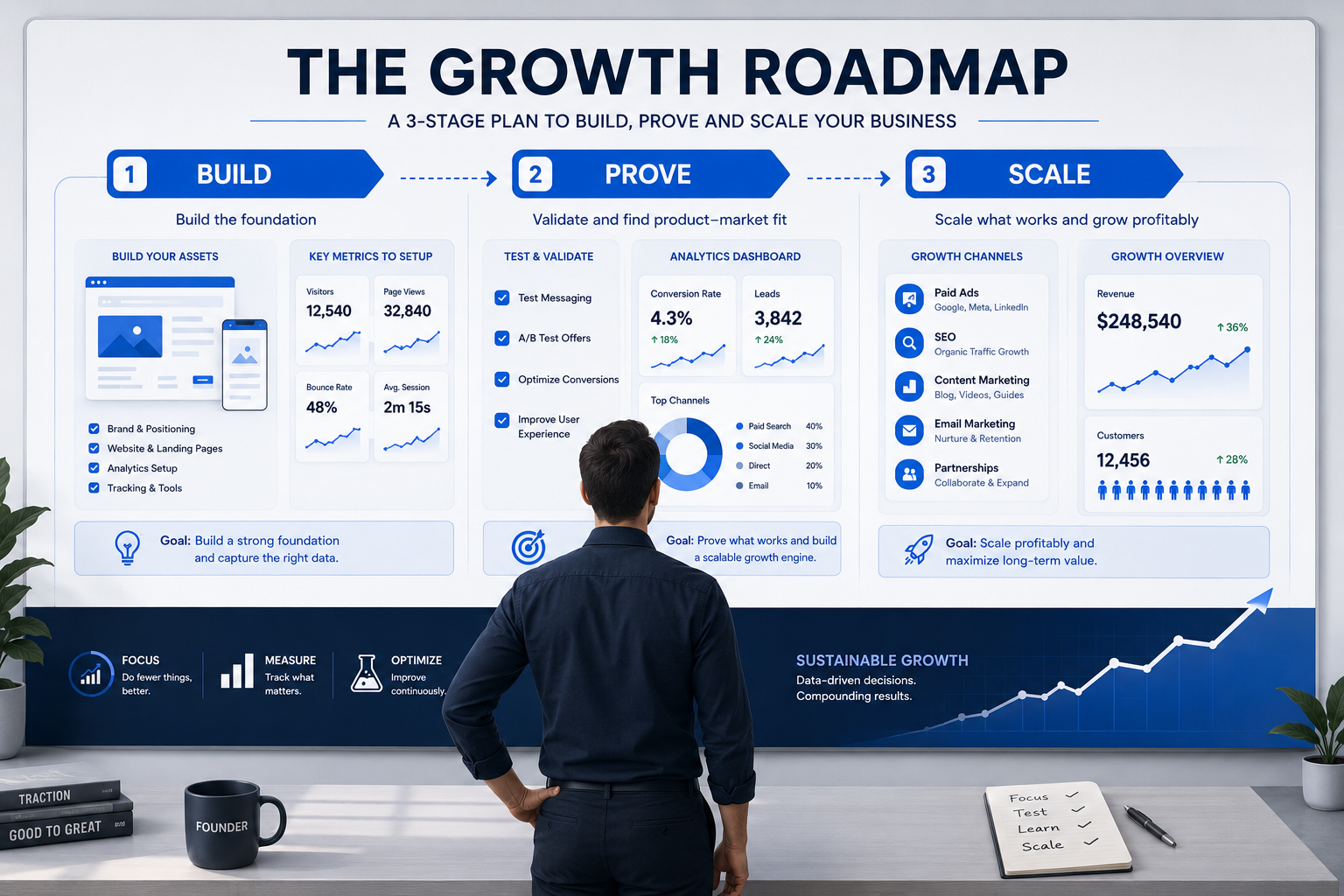
- How the Build → Prove → Scale Method™ helps founder-led startups create predictable, evidence-based growth
What's Actually at Stake in the First 90 Days
The first 90 days establish the systems that every future marketing initiative will rely on.
If your positioning is unclear, your website doesn't convert, or your analytics are incomplete, increasing your marketing budget later won't solve those problems. Instead, it simply makes expensive mistakes happen faster.
Think of the first three months as laying the foundation before building a house.
A strong foundation allows you to:
- Attract the right audience
- Measure performance accurately
- Optimise marketing with confidence
- Scale without unnecessary risk
Skipping these steps often leads to:
- Inconsistent lead generation
- Rising Customer Acquisition Costs (CAC)
- Poor conversion rates
- Conflicting messaging
- Uncertainty about which channels actually generate revenue
Successful founders resist the temptation to chase quick wins. Instead, they invest early in building a marketing system that compounds over time.
Month 1 – Build the Foundation
The first month isn't about generating as many leads as possible.
It's about creating the infrastructure that makes future campaigns successful.
Every decision made during this phase should answer one question:
Are we building a marketing system that can scale?
Define Your Ideal Customer Profile (ICP)
Marketing becomes dramatically easier when you know exactly who you're trying to reach.
Rather than targeting everyone who might benefit from your product, identify the customers who are most likely to buy, stay, and generate long-term value.
Your Ideal Customer Profile should include:
- Industry
- Company size
- Business stage
- Decision-makers
- Common pain points
- Buying triggers
- Goals and priorities
The clearer your ICP, the easier it becomes to create messaging that resonates.
Clarify Your Positioning
One of the biggest reasons startup marketing struggles is weak positioning.
If prospects can't immediately understand:
- What You Do
- Who You Help
- Why you're different
they're unlikely to continue exploring your business.
Strong positioning should answer four questions:
- Who is your ideal customer?
- What problem do you solve?
- Why should customers choose you?
- Why are you different from competitors?
When positioning is clear, every marketing channel becomes more effective.
Build a Conversion-Focused Website
Your website shouldn't simply describe your business.
It should help visitors become qualified leads.
During the first month, prioritise:
- clear value propositions
- compelling calls to action
- fast loading speeds
- mobile optimisation
- simple navigation
- trust signals
- customer testimonials
- easy enquiry forms
Every future marketing campaign will send traffic to your website, making it one of your most valuable business assets.
Implement Tracking Before Campaigns
One of the most common startup mistakes is launching campaigns before measurement is in place.
Before investing in customer acquisition, configure:
- Google Analytics
- conversion tracking
- CRM integration
- lead source attribution
- event tracking
- reporting dashboards
Without reliable data, it's impossible to know which activities contribute to business growth.
Month 2 – Validate What Works
Once the foundation has been established, the second month focuses on learning.
Rather than launching every available marketing channel, successful startups choose one acquisition strategy and measure its performance carefully.
The objective isn't rapid growth.
It's reliable evidence.
Choose One Primary Acquisition Channel
Every startup eventually benefits from multiple marketing channels.
However, trying to manage SEO, Google Ads, LinkedIn, email marketing, webinars, and partnerships simultaneously usually spreads resources too thin.
Instead, choose one channel based on:
- Where Your Customers Research Solutions
- Available Budget
- Internal Expertise
- Expected Sales Cycle
- Available Content Resources
For many B2B technology startups, this might be:
- SEO
- Google Ads
- Content marketing
The goal is to prove one channel before expanding into others.
Measure Business Outcomes
Avoid focusing solely on marketing activity.
Instead of celebrating impressions or website traffic, monitor metrics that reflect commercial performance.
Track:
- Qualified Leads
- Customer Acquisition Cost (CAC)
- Conversion Rate
- Marketing Qualified Leads (MQLS)
- Sales Qualified Leads (SQLS)
- Pipeline Value
- Return On Marketing Investment (ROMI)
These indicators reveal whether your marketing is creating real business value.
Refine Based on Evidence
Very few campaigns perform perfectly from the start.
Use early performance data to improve:
- Messaging
- Landing Pages
- Offers
- Audience Targeting
- Calls To Action
- Lead Nurturing
Small improvements made consistently often produce larger gains than launching entirely new campaigns.
Month 3 – Scale With Confidence
By the third month, your goal isn't to "do more marketing." It's to expand what has already proven successful.
If you've spent the first 60 days building a solid foundation and validating one acquisition channel, you'll now have enough data to make smarter growth decisions.
Instead of asking:
"What new marketing tactic should we try?"
Ask:
- Which activities consistently generate qualified leads?
- Which campaigns produce the strongest return?
- Where are prospects dropping out of the buying journey?
- Which improvements will create the biggest business impact?
These answers should determine your next move.
Scaling based on evidence reduces risk, improves budget efficiency, and creates predictable growth.
Increase Investment in Proven Channels
Not every marketing channel deserves additional investment.
Only increase spending when a channel consistently delivers measurable business outcomes.
Signs a channel is ready to scale include:
- Stable Customer Acquisition Cost (CAC)
- Consistent lead quality
- Healthy conversion rates
- Reliable pipeline generation
- Positive Return on Marketing Investment (ROMI)
For example, if your SEO strategy consistently generates qualified demo requests, increasing your content production makes sense.
If LinkedIn thought leadership is producing high-value conversations with decision-makers, publishing more frequently may create even stronger results.
Scale what works, not what feels exciting.
Optimise Before Expanding
Many founders assume growth comes from adding new marketing channels.
In reality, the biggest opportunities often exist within your existing system.
Before launching another acquisition channel, optimise what you've already built.
Review:
- Landing page conversion rates
- Calls to action
- Website messaging
- Sales follow-up process
- Lead nurturing emails
- Content performance
- Audience targeting
Improving conversion rates by just a few percentage points often produces better results than doubling your advertising budget.
Optimisation compounds over time.
Document Your Marketing System
Growth shouldn't rely on one founder remembering how everything works.
As your marketing matures, document your processes.
This includes:
- Brand messaging
- Campaign workflows
- Reporting procedures
- Customer journey
- Content guidelines
- Lead qualification
- Automation workflows
Documentation makes your marketing repeatable.
It also allows your business to grow without becoming dependent on one person.
The Biggest Mistakes Founders Make During Their First 90 Days
Most startup marketing failures don't happen because founders lack ambition.
They happen because businesses try to accelerate before they've built the foundations needed for sustainable growth.
Here are the mistakes Corient sees most often.
Trying Every Marketing Channel
Launching SEO, Google Ads, LinkedIn, email marketing, webinars, and social media simultaneously creates complexity instead of momentum.
Every channel requires time, expertise, and consistent optimisation.
Instead of mastering one, startups end up making limited progress across many.
Focus first.
Expand later.
Prioritising Activity Over Outcomes
Publishing more content doesn't automatically create more customers.
Running more ads doesn't guarantee revenue.
Marketing activity is only valuable when it produces measurable business outcomes.
Monitor metrics that matter:
- Qualified leads
- Sales opportunities
- Pipeline value
- Revenue attribution
- Customer Acquisition Cost
- Customer Lifetime Value
These indicators reveal whether your marketing is contributing to growth.
Ignoring Attribution
Without accurate attribution, founders struggle to answer questions like:
- Which marketing channel generated this customer?
- Which campaign influenced revenue?
- Where are prospects leaving the funnel?
- Which investments deserve a larger budget?
Reliable attribution removes guesswork from decision-making.
It turns marketing into a measurable business function rather than a collection of disconnected activities.
Scaling Before Validation
Early success doesn't always mean long-term success.
One successful campaign isn't enough evidence to justify doubling your marketing budget.
Before expanding, ask:
- Can we repeat these results?
- Are conversion rates consistent?
- Is customer acquisition profitable?
- Do we understand why this channel works?
Only then should scaling begin.
How to Build a Repeatable Marketing System
The startups that grow consistently don't rely on luck.
They build systems.
A repeatable marketing system connects every stage of customer acquisition into one measurable process.
It typically includes:
Positioning
A clear understanding of who you help, what problem you solve, and why customers should choose you.
Conversion
A website that consistently turns visitors into qualified leads.
Measurement
Analytics and attribution that connect marketing activity to business outcomes.
Customer Journey
A documented process that moves prospects from awareness to purchase.
Continuous Optimisation
Regular improvements based on real customer behaviour rather than assumptions.
When these elements work together, marketing becomes predictable instead of reactive.
Why Evidence Beats Speed
Many founders believe speed creates competitive advantage.
Sometimes it does.
But moving quickly in the wrong direction simply gets you lost faster.
Evidence-based marketing creates sustainable growth because every decision builds on proven performance.
Instead of asking:
"How fast can we grow?"
Successful founders ask:
- What does the data tell us?
- Which improvements produce measurable results?
- Where should we invest next?
This mindset reduces wasted marketing spend while increasing confidence in every future decision.
Growth becomes deliberate rather than accidental.
How Corient Supports the First 90 Days of Startup Growth
The first 90 days of marketing shouldn't be filled with random experiments or disconnected campaigns. They should be focused on building a repeatable system that gives founders confidence in every marketing decision.
That's the thinking behind The Corient System™.
Rather than encouraging startups to launch every available marketing tactic, Corient helps founder-led businesses build the right foundations first, prove what works through measurable performance, and scale only when the evidence supports it.
The methodology follows three simple stages.
Build
During the first month, Corient focuses on creating the infrastructure that supports long-term growth.
This includes:
- Defining your Ideal Customer Profile (ICP)
- Clarifying positioning and messaging
- Building a conversion-focused website
- Setting up analytics and attribution
- Mapping the customer journey
- Creating performance dashboards
- Aligning marketing objectives with business goals
Instead of rushing into campaigns, founders gain clarity about who they're targeting, how they'll measure success, and what sustainable growth should look like.
Prove
Once the foundations are in place, attention shifts to validating a single acquisition strategy.
Rather than spreading resources across multiple channels, Corient identifies the channel with the highest potential and measures its effectiveness using business-focused metrics.
These include:
- Customer Acquisition Cost (CAC)
- Marketing Qualified Leads (MQLs)
- Sales Qualified Leads (SQLs)
- Conversion rate
- Pipeline value
- Return on Marketing Investment (ROMI)
- Revenue attribution
The goal isn't simply to generate leads. It's to demonstrate that customer acquisition is predictable, profitable, and repeatable.
Scale
Only after consistent performance has been proven does Corient recommend increasing investment.
Scaling may include:
- Expanding SEO and content marketing
- Increasing paid media budgets
- Introducing lifecycle email marketing
- Automating lead nurturing
- Launching complementary acquisition channels
- Optimising sales and marketing alignment
Because every decision is backed by measurable data, startups reduce unnecessary risk while building a marketing engine that becomes stronger over time.
Instead of chasing growth, they're creating a system designed to sustain it.
Frequently Asked Questions
What should startups focus on during the first 90 days of marketing?
The first 90 days should focus on building the foundations for long-term growth. That includes defining your Ideal Customer Profile, refining your positioning, creating a high-converting website, implementing accurate tracking, and validating one customer acquisition channel before expanding.
How long should startups test a marketing channel?
There's no fixed timeframe.
Rather than scaling based on time alone, founders should wait until they have enough reliable data to confirm that a channel consistently generates qualified leads and profitable customer acquisition.
Evidence should determine when to scale, not the calendar.
Should startups use multiple marketing channels from the beginning?
Usually not.
Managing several channels simultaneously often spreads budgets and resources too thin.
Most successful startups prove one acquisition channel first before expanding into additional channels.
Which metrics matter most during the first 90 days?
Instead of focusing on vanity metrics like impressions or followers, founders should monitor:
- Customer Acquisition Cost (CAC)
- Conversion rate
- Marketing Qualified Leads (MQLs)
- Sales Qualified Leads (SQLs)
- Pipeline value
- Revenue attribution
- Return on Marketing Investment (ROMI)
These metrics provide a clearer picture of whether marketing is contributing to business growth.
Final Thoughts
The first 90 days of startup marketing set the direction for everything that follows.
Founders who spend this time chasing every new tactic often end up with disconnected campaigns, rising acquisition costs, and little confidence in what's actually driving growth.
The businesses that scale successfully take a different approach.
They build strong foundations, validate one acquisition channel through measurable results, and expand only after they've proven what works.
This disciplined process doesn't slow growth; it makes growth more predictable.
When every marketing decision is guided by evidence rather than assumptions, budgets become more efficient, customer acquisition becomes more consistent, and scaling becomes significantly less risky.
At Corient, we help founder-led startups replace guesswork with a structured marketing system. Through our Build → Prove → Scale methodology, we help businesses establish the right foundations, validate customer acquisition, and create repeatable growth that lasts.
If you're planning your next stage of growth, talk to Corient about building a marketing system that's designed to scale with your business, not just your marketing budget.
Check out more articles below:
- Founder-Led Marketing: Why Startups Need a Marketing System Instead of Just More Campaigns
- Why Most Startup Marketing Strategies Fail Before They Ever Scale
- What Is a Marketing Operating System? Why Founder-Led Tech Startups Are Moving Beyond Traditional Marketing Agencies
- 10 Signs Your Startup Isn't Ready to Scale Marketing Yet