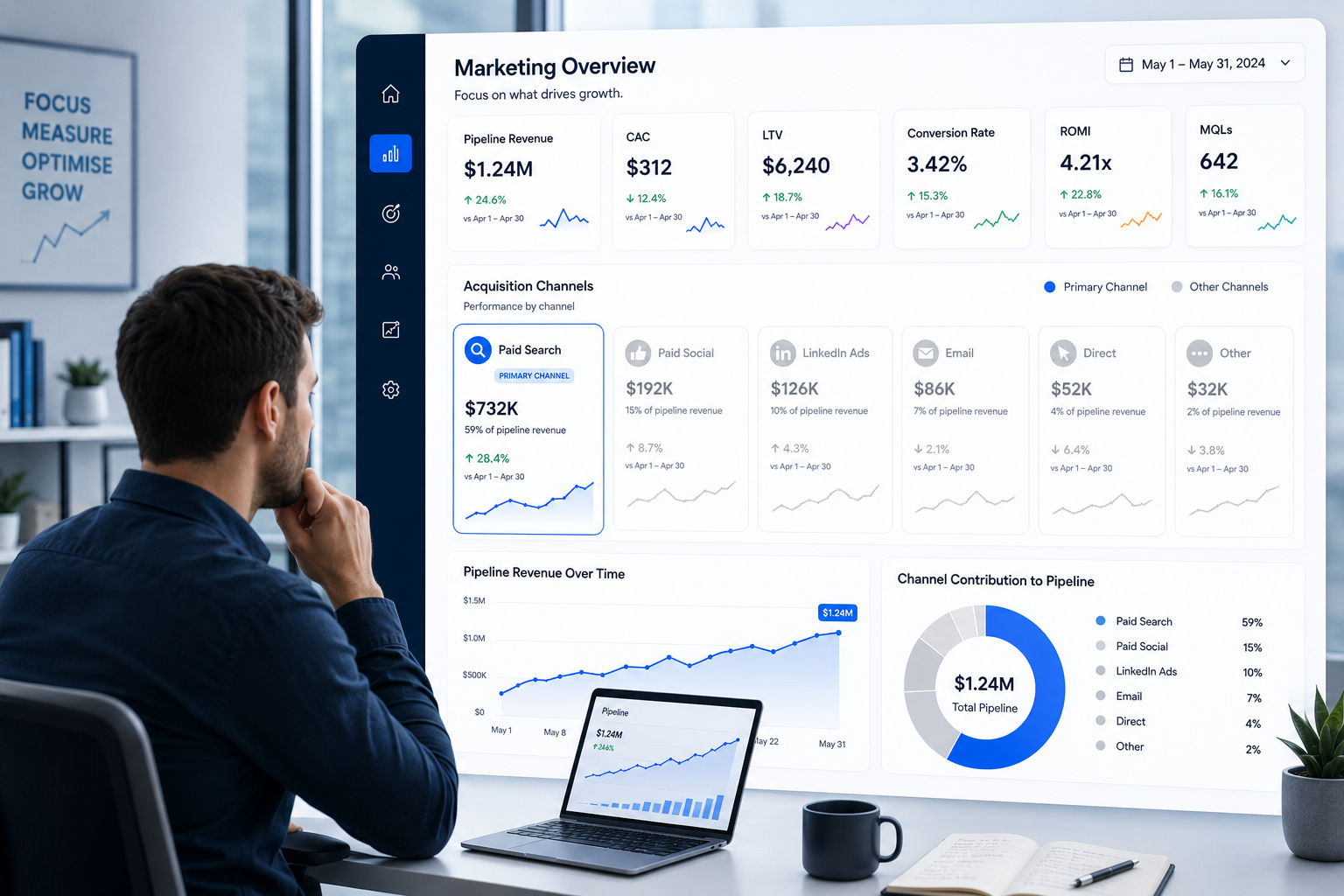
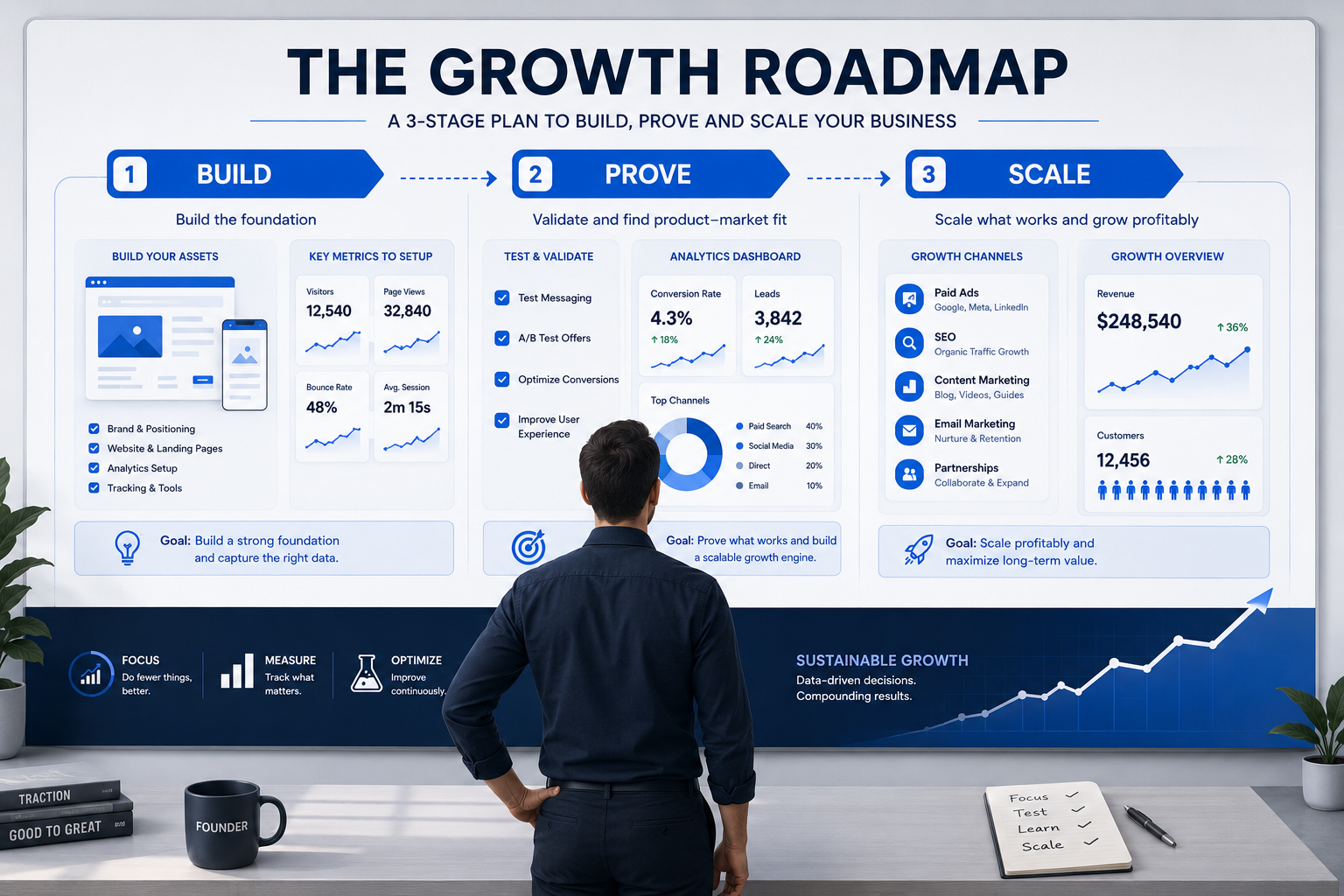
For many founder-led startups, marketing decisions happen under pressure. A campaign underperforms, so the budget shifts to another channel. A competitor launches LinkedIn Ads, so you follow suit. Soon you're juggling SEO, paid ads, webinars, email marketing, and social content, all at once. It feels productive, but more activity doesn't always create better results.
The problem isn't a lack of effort; it's a lack of evidence. When marketing decisions are driven by assumptions instead of measurable performance, businesses often waste budget on channels that don't convert, struggle to identify what's driving the pipeline, and make scaling decisions without reliable data.
Evidence-based marketing changes that.
Instead of asking, "What should we try next?" it asks:
- What does the data tell us?
- Which channels consistently generate qualified pipelines?
- Which campaigns influence revenue?
- Where are prospects dropping out of the buying journey?
- What should we improve before investing more?
These questions shift marketing from reactive decision-making to a repeatable growth system. For founder-led startups with limited budgets and ambitious growth targets, that's a significant advantage.
In this article, you'll learn:
- What evidence-based marketing is and why it matters
- Why guesswork leads to wasted budget and inconsistent growth
- The key metrics founders should use to guide marketing decisions
- How to build a data-driven marketing system that scales with confidence
What Is Evidence-Based Marketing?
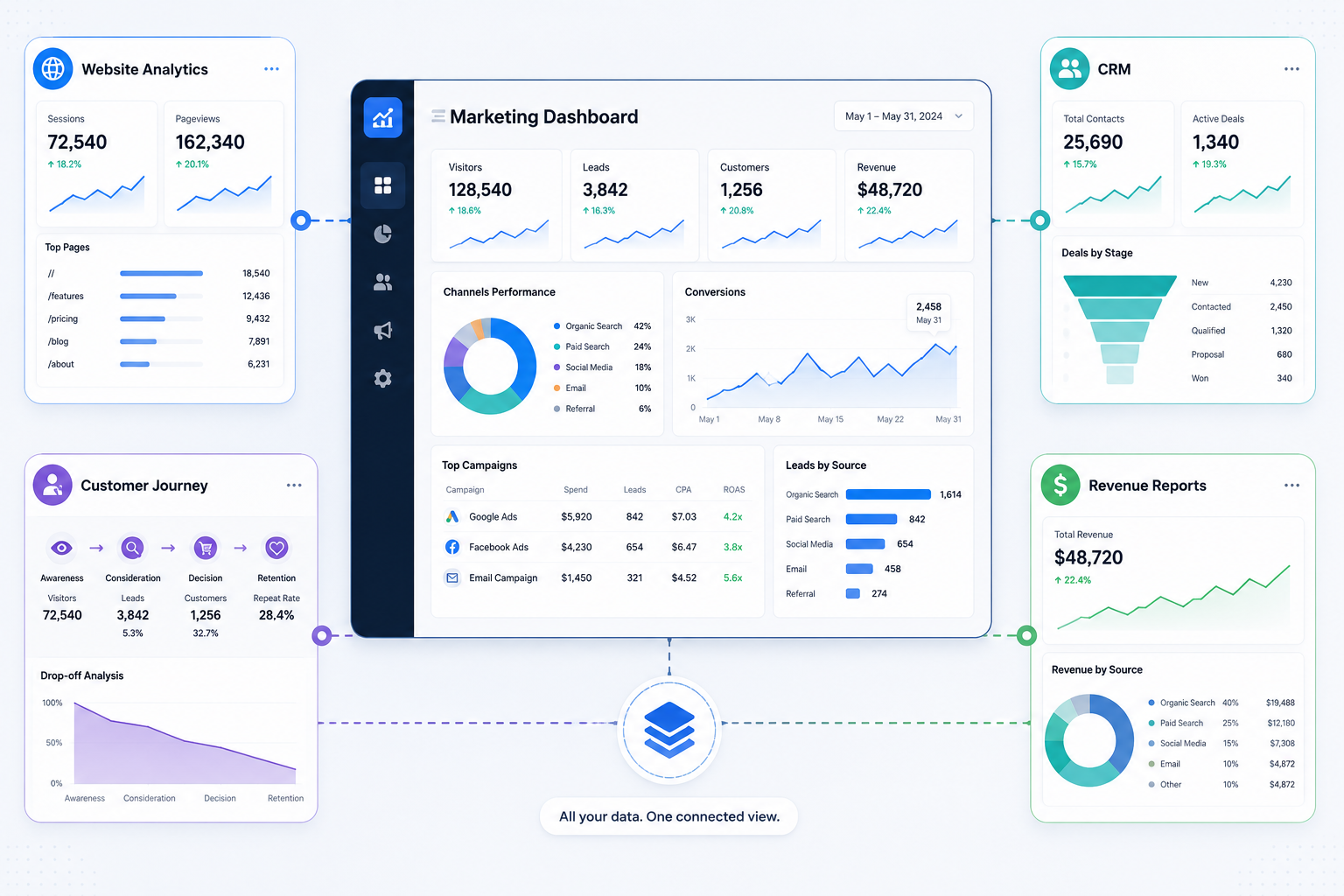
Evidence-based marketing is the practice of making marketing decisions based on measurable data instead of assumptions, opinions, or trends.
Instead of asking, "What should we try next?", businesses ask questions that can be answered with evidence.
- Which channels generate qualified leads?
- Which campaigns contribute to pipeline?
- Where are prospects leaving the buying journey?
- Which marketing investments produce profitable customers?
- What should we improve before increasing spend?
Every campaign becomes an opportunity to learn. Marketing activities are measured, customer behaviour is analysed, and future decisions are based on proven performance rather than intuition.
The objective isn't simply to collect more data. It's to use that data to reduce uncertainty, improve marketing performance, and create a repeatable system for customer acquisition.
Why It's Different from Traditional Marketing
Traditional marketing often begins with tactics.
A business hires an agency, launches advertising campaigns, redesigns its website, or starts publishing content. Success is commonly measured through campaign metrics such as impressions, clicks, website traffic, or social engagement.
While those metrics can indicate activity, they don't always explain whether marketing is contributing to business growth.
Evidence-based marketing starts somewhere different.
Before increasing investment, businesses first evaluate whether existing marketing activities are producing meaningful commercial outcomes.
Instead of asking:
"Which campaign should we launch next?"
They ask:
- Are we attracting the right customers?
- Is customer acquisition profitable?
- Which channels influence revenue?
- Can these results be repeated consistently?
Campaigns still matter, but they exist within a broader process of measurement, testing, and continuous improvement.
This shift helps founder-led startups make more confident decisions while reducing unnecessary marketing risk.
Evidence-Based Marketing vs Traditional Marketing
Although the two approaches may appear similar, they produce very different outcomes.
Traditional marketing often focuses on activity.
Typical questions include:
- Which platform should we advertise on?
- Which campaign should we launch?
- How much content should we publish?
- Which agency should we hire?
Evidence-based marketing starts with business outcomes.
Instead, it asks:
- Who are our highest-value customers?
- Which acquisition channels generate profitable growth?
- Which messages improve conversion?
- Where do prospects leave the customer journey?
- Which investments produce measurable commercial results?
The difference isn't simply about using more data.
It's about making every marketing decision accountable to business performance.
Instead of doing more marketing, startups learn how to make better marketing decisions.
Why Founder-Led Startups Need Evidence-Based Marketing
Founder-led startups rarely have unlimited resources.
Marketing budgets are tighter. Teams are smaller. Every investment needs to contribute to meaningful business growth.
Unlike larger organisations that can absorb unsuccessful campaigns, startups often have little room for costly experimentation. One poor investment can increase customer acquisition costs, delay growth, or reduce available runway.
Evidence-based marketing helps founders make smarter decisions by providing clear visibility into what's working and what isn't.
Instead of relying on instinct alone, founders gain answers to important questions such as:
- Should we increase advertising spend?
- Is our website converting enough visitors?
- Which acquisition channels generate our best customers?
- Which messages resonate most with buyers?
- Where should we invest next?
Having reliable answers allows startups to prioritise opportunities with greater confidence while avoiding unnecessary marketing spend.
The Hidden Cost of Marketing Guesswork
Most marketing mistakes don't happen because founders aren't working hard.
They happen because decisions are made before enough evidence exists.
Guesswork often feels productive.
New campaigns launch. Budgets increase. Additional tools are introduced. More marketing channels are added.
But without accurate measurement, businesses rarely know whether those activities are actually contributing to pipeline or revenue.
Over time, this creates hidden costs that become increasingly expensive as startups grow.
Spending Before Understanding Customers
One of the most common mistakes startups make is investing heavily in customer acquisition before clearly understanding who their ideal customers are.
Without a defined Ideal Customer Profile (ICP), marketing becomes broad and inconsistent.
Advertising targets the wrong audience.
Website messaging tries to appeal to everyone.
Content answers questions that qualified buyers aren't asking.
The result is predictable.
- Customer acquisition costs increase.
- Conversion rates remain low.
- Sales teams spend time qualifying poor-fit leads.
- Marketing budgets stretch further without producing better outcomes.
For example, a SaaS founder may invest thousands of dollars into paid advertising before validating whether their messaging resonates with decision-makers. The problem isn't the advertising platform; it's the lack of customer insight guiding the campaign.
Understanding customer behaviour first allows every future marketing investment to perform more effectively.
Choosing Channels Because Competitors Use Them
It's easy to assume that if competitors are investing in a particular marketing channel, your business should do the same.
You see competitors running LinkedIn Ads, publishing podcasts, investing in SEO, or hosting webinars.
So naturally, you follow.
The problem is that you're copying activities without understanding whether they support your own business objectives.
Your competitors may have:
- Different audiences
- Different pricing models
- Different sales cycles
- Larger marketing teams
- Bigger advertising budgets
What works for them may not work for your startup.
Evidence-based marketing removes this assumption by helping founders evaluate their own performance data before deciding where to invest.
Instead of following competitors, businesses can focus on the channels that consistently generate qualified leads, profitable customers, and sustainable growth.
Measuring Vanity Metrics Instead of Business Outcomes
Many startups celebrate marketing reports filled with impressive-looking numbers:
- Website traffic
- Social media followers
- Post impressions
- Video views
- Email subscribers
While these metrics can indicate awareness, they don't necessarily indicate business growth.
A startup can attract thousands of website visitors every month and still struggle to generate qualified leads or revenue.
Evidence-based marketing shifts the focus to metrics that directly influence commercial performance, including:
- Customer Acquisition Cost (CAC)
- Marketing Qualified Leads (MQLs)
- Sales Qualified Leads (SQLs)
- Conversion Rate
- Pipeline Revenue
- Return on Marketing Investment (ROMI)
These metrics help founders understand not just whether marketing is active, but whether it's contributing to sustainable growth.
Scaling Campaigns Before They're Proven
One of the most expensive marketing mistakes startups make is increasing investment before understanding why a campaign performed well.
Imagine a founder launches a paid advertising campaign that generates a handful of promising leads. Encouraged by the initial results, they immediately double the budget, add another marketing channel, and increase spending.
A few months later, marketing costs have increased dramatically, but revenue hasn't followed.
The original campaign may have succeeded because of timing, audience selection, or market conditions rather than a repeatable acquisition process.
Before increasing investment, founders should ask:
- Can these results be repeated consistently?
- Is customer acquisition profitable?
- What is driving conversions?
- Do we have enough evidence to justify scaling?
Answering these questions first helps reduce unnecessary risk while improving the return on future marketing investment.
The Five Principles of Evidence-Based Marketing

Evidence-based marketing isn't about collecting more reports or installing more analytics tools. It's about creating a decision-making process that reduces uncertainty and improves performance over time.
Founder-led startups that consistently grow follow a few core principles that keep every marketing investment accountable.
1. Measure What Matters
If you can't measure it, you can't improve it.
Many businesses focus on website visits, clicks, or social engagement because those metrics are easy to access. However, they rarely show whether marketing is generating meaningful business outcomes.
Instead, focus on questions like:
- How many qualified leads did this campaign generate?
- What was our Customer Acquisition Cost (CAC)?
- How much pipeline did marketing influence?
- Did this investment create profitable customers?
When marketing is measured against commercial outcomes rather than activity, it's much easier to decide where future investment should go.
2. Test Before Expanding
One successful campaign doesn't automatically mean you've found a scalable growth channel.
Treat every campaign as an experiment.
Rather than increasing budgets immediately, evaluate whether the results are consistent over time.
Ask questions such as:
- Can these results be repeated?
- Which variables influenced performance?
- What can we improve before investing more?
This disciplined approach reduces unnecessary spending and helps businesses build confidence before committing larger budgets
3. Let Customer Behaviour Guide Strategy
Customers constantly provide valuable feedback through their actions.
Every search query, click, download, enquiry, and conversion reveals something about how people interact with your business.
Instead of relying on opinions, use customer behaviour to answer questions such as:
- Which content generates enquiries?
- Which landing pages convert best?
- Which email campaigns influence sales?
- Which acquisition channels attract the highest-value customers?
Over time, these insights become one of the most valuable inputs for future marketing decisions.
4. Build Repeatable Systems
Sustainable growth rarely comes from a single successful campaign.
It comes from creating marketing processes that can consistently deliver results.
That includes:
- Clear positioning
- Consistent messaging
- Reliable tracking
- Standard reporting
- Documented workflows
- Regular optimisation
When marketing becomes systematic instead of reactive, improvements compound over time.
5. Continuously Optimise
Evidence-based marketing isn't something you implement once and forget.
Markets change.
Customer behaviour evolves.
Competitors introduce new offers.
Technology improves.
The most successful startups review performance regularly, identify opportunities for improvement, and make incremental changes based on evidence.
Small improvements across conversion rates, acquisition costs, or customer retention can create significant long-term gains.
What Metrics Should Startups Actually Track?
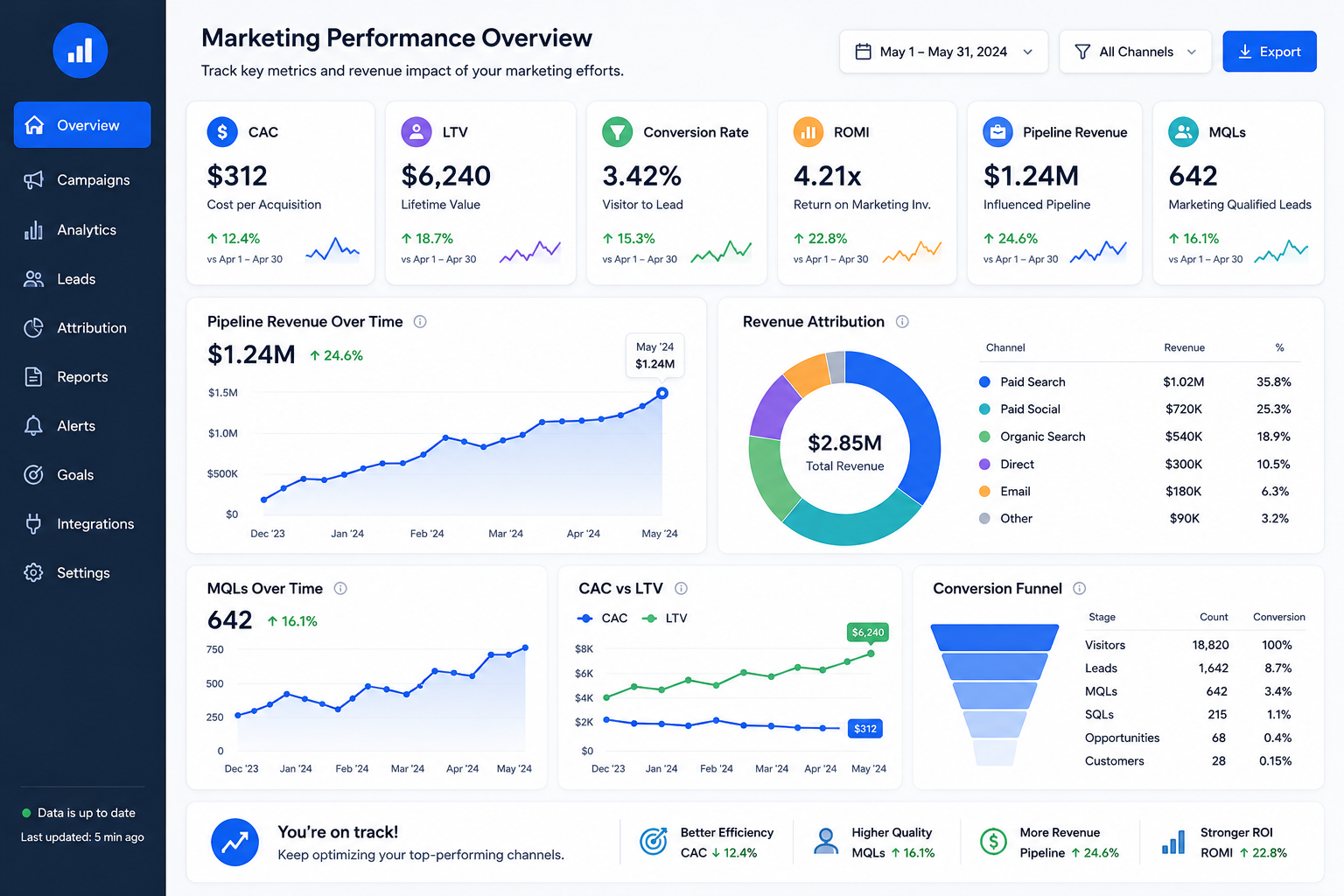
Founder-led startups should focus on measurements that directly influence revenue, profitability, and customer acquisition.
Here are the metrics that matter most.
Customer Acquisition Cost (CAC)
CAC measures how much it costs to acquire one paying customer.
It helps founders answer:
- Is marketing profitable?
- Can we afford to scale?
- Which acquisition channels are most efficient?
Without knowing CAC, increasing marketing spend becomes a high-risk decision.
Customer Lifetime Value (LTV)
LTV estimates the total revenue a customer generates throughout their relationship with your business.
When combined with CAC, founders can determine whether customer acquisition is commercially sustainable.
A healthy business typically aims for customers to generate significantly more value than they cost to acquire.
Marketing Qualified Leads (MQLs)
MQLs are prospects who have shown enough interest to indicate they may become customers.
Examples include:
- Downloading valuable resources
- Booking a consultation
- Requesting product information
- Registering for webinars
Tracking MQLs helps measure whether marketing is attracting the right audience, not just generating traffic.
Sales Qualified Leads (SQLs)
SQLs are leads that sales teams consider ready for direct engagement.
Monitoring SQLs helps identify whether marketing is producing prospects that progress through the sales pipeline.
Conversion Rate
Conversion rate measures how effectively visitors move from one stage of the customer journey to the next.
This may include:
- Website visitor to lead
- Lead to opportunity
- Opportunity to customer
Improving conversion rates often delivers a greater return than simply increasing traffic.
Pipeline Revenue
Pipeline revenue measures the value of opportunities created through marketing.
Rather than focusing only on lead volume, startups should understand how marketing contributes to future revenue.
A smaller number of high-value opportunities often creates better business outcomes than a large volume of unqualified leads.
Revenue Attribution
Revenue attribution connects marketing activities to commercial outcomes.
It answers questions such as:
- Which channels generate revenue?
- Which campaigns influence buying decisions?
- Which content contributes to conversions?
Without attribution, marketing investment becomes difficult to optimise.
Return on Marketing Investment (ROMI)
ROMI measures the financial return generated by marketing spend.
Instead of asking whether marketing was busy, founders can determine whether it created profitable business growth.
ROMI allows startups to invest confidently in activities that consistently produce measurable returns.
Evidence-Based Marketing in Action
Understanding the theory behind evidence-based marketing is one thing. Applying it to real business decisions is where it creates real value.
Imagine a founder who believes LinkedIn Ads are the best way to generate leads because competitors are active on the platform.
Instead of increasing the advertising budget immediately, an evidence-based approach asks a different set of questions:
- Is LinkedIn generating qualified opportunities?
- How does the cost per acquisition compare with other channels?
- Which channel produces the highest customer lifetime value?
- Are leads from LinkedIn converting into revenue?
After reviewing the data, the results might tell a different story.
Rather than increasing spend on the loudest channel, the founder can invest in the channels already producing measurable commercial outcomes.
This approach doesn't remove creativity from marketing. It simply ensures that every major decision is backed by evidence rather than assumptions.
Common Marketing Decisions That Should Be Based on Data
Every startup makes dozens of marketing decisions each month. The difference between inconsistent growth and sustainable growth often comes down to how those decisions are made.
Instead of relying on instinct alone, founders should use measurable performance to answer questions such as:
Should We Increase Our Advertising Budget?
Before investing more, determine whether existing campaigns are already generating profitable customers. Scaling an underperforming campaign usually increases wasted spend rather than results.
Which Content Should We Create?
Look at search demand, customer questions, website engagement, and conversion data instead of publishing content based on assumptions.
Which Audience Converts Best?
Different customer segments behave differently. Analyse conversion rates, pipeline quality, and lifetime value to identify where future investment will have the greatest impact.
Which Landing Page Performs Better?
A/B testing removes guesswork by showing which messaging, design, or calls to action consistently generate more enquiries.
Should We Hire Another Marketing Agency?
Before adding another specialist, assess whether the challenge is execution or a lack of strategy, measurement, or internal systems.
Which Marketing Channel Should We Scale Next?
Only expand into additional channels after one has demonstrated predictable, repeatable performance.
Evidence-based marketing turns these decisions into measurable business improvements instead of expensive experiments.
How Corient Uses Evidence to Drive Growth
Many agencies focus on delivering campaigns.
Corient focuses on building a marketing system that helps founder-led startups make better decisions, improve performance over time, and scale with confidence.
This is where the Build → Prove → Scale Method™ comes in.
Rather than encouraging businesses to invest more from day one, the methodology helps founders reduce risk by validating each stage of growth before moving to the next.
Build
The first step is creating the foundations needed for sustainable growth.
This includes:
- Defining a clear market position
- Aligning messaging across every touchpoint
- Improving website conversion paths
- Implementing analytics and attribution
- Establishing meaningful reporting
Without these fundamentals, even successful campaigns become difficult to measure or repeat.
Prove
Once the foundation is established, the next priority is validation.
Rather than spreading resources across multiple channels, Corient helps founders identify one acquisition strategy, test it thoroughly, and measure outcomes that matter, including:
- Customer Acquisition Cost (CAC)
- Qualified pipeline
- Conversion rates
- Revenue attribution
- Return on Marketing Investment (ROMI)
The objective isn't simply to generate results once. It's to prove they can be repeated consistently.
Scale
Growth should be earned through evidence, not optimism.
Once a channel consistently delivers profitable outcomes, investment can increase with far greater confidence.
Whether that means expanding SEO, increasing advertising budgets, introducing lifecycle marketing, or adding new acquisition channels, every decision is supported by measurable performance rather than assumptions.
That's how startups create predictable growth instead of chasing short-term wins.
Signs Your Marketing Is Based on Guesswork
Not sure whether your marketing strategy is driven by evidence or assumptions?
Use this checklist.
If you answer "Yes" to several of these statements, it may be time to strengthen your marketing foundations before scaling.
- You can't clearly explain where your leads come from.
- You don't know your Customer Acquisition Cost (CAC).
- Your reports focus on impressions, clicks, or followers rather than revenue.
- Different marketing channels tell different stories about performance.
- Marketing decisions rely on opinions instead of data.
- Your messaging changes every few months.
- You aren't sure why your best-performing campaigns succeeded.
- You invest in channels because competitors use them.
- You struggle to connect marketing activity to pipeline or revenue.
- You're increasing budgets without validating what's working.
The more boxes you tick, the greater the opportunity to improve marketing performance through evidence-based decision-making.
Frequently Asked Questions
What is evidence-based marketing?
Evidence-based marketing is the practice of using measurable data, customer behaviour, and performance insights to guide marketing decisions instead of relying on assumptions or opinions.
Why is marketing attribution important?
Marketing attribution helps businesses understand which channels, campaigns, and touchpoints contribute to leads, sales, and revenue. It enables smarter budget allocation and better decision-making.
Which marketing metrics matter most for startups?
Founders should prioritise metrics that demonstrate business performance, including Customer Acquisition Cost (CAC), Customer Lifetime Value (LTV), Marketing Qualified Leads (MQLs), Sales Qualified Leads (SQLs), conversion rate, pipeline revenue, revenue attribution, and Return on Marketing Investment (ROMI).
What's the difference between data-driven and evidence-based marketing?
Data-driven marketing focuses on collecting and analysing data. Evidence-based marketing goes a step further by using that data to validate decisions, test hypotheses, and build repeatable systems before scaling investment.
How do startups start measuring marketing correctly?
Start by implementing reliable analytics, conversion tracking, CRM integration, and marketing attribution. Once accurate data is available, focus on measuring commercial outcomes such as qualified leads, pipeline growth, customer acquisition costs, and revenue rather than surface-level engagement metrics.
Final Thoughts
Marketing shouldn't rely on opinions.
For founder-led startups, every marketing investment should produce more than leads or clicks; it should generate measurable learning that improves future decisions.
Evidence-based marketing helps founders understand which channels create qualified pipelines, which campaigns influence revenue, and where marketing budgets generate the greatest return. Instead of chasing trends or copying competitors, businesses build confidence through testing, measurement, and continuous optimisation.
The startups that scale successfully aren't the ones doing the most marketing. They're the ones making the smartest marketing decisions.
If you're ready to replace guesswork with measurable growth, Corient can help. Through our Build → Prove → Scale Method™, we help founder-led startups build the systems, tracking, and insights needed to make confident marketing decisions and scale sustainably.
Talk to Corient today to build a marketing system driven by evidence, not assumptions, and create predictable, long-term growth.
Check out more articles below:
- Founder-Led Marketing: Why Startups Need a Marketing System Instead of Just More Campaigns
- Why Most Startup Marketing Strategies Fail Before They Ever Scale
- What Is a Marketing Operating System? Why Founder-Led Tech Startups Are Moving Beyond Traditional Marketing Agencies
- 10 Signs Your Startup Isn't Ready to Scale Marketing Yet