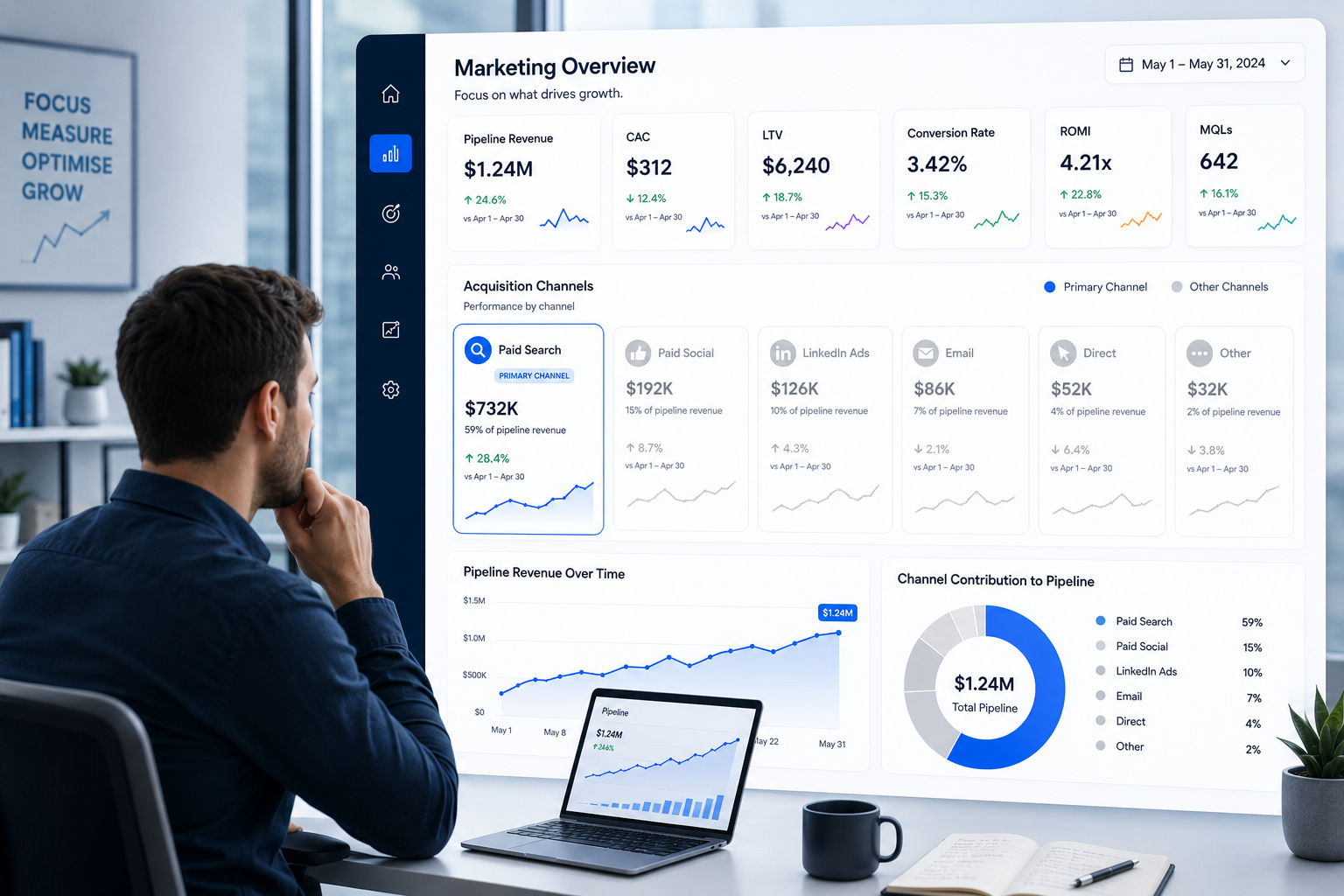
Every founder wants to grow faster.
After landing your first customers, seeing early traction, or closing a funding round, it's tempting to increase your marketing budget, hire an agency, or expand into new acquisition channels. It feels like the logical next step. But scaling marketing before you've proven what works is one of the fastest ways to waste budget, create inconsistent results, and slow long-term growth.
The most successful startups don't grow by doing more marketing. They grow by building a system that identifies what works, validates it with data, and scales it with confidence. That's the principle behind the Build → Prove → Scale framework, a practical approach that helps founder-led startups reduce risk and create predictable, sustainable growth.
In this article, we'll cover:
- How the Build → Prove → Scale framework works
- Why evidence-based marketing outperforms guesswork
- Common mistakes founders make when scaling too early
- How to build a repeatable marketing system that supports sustainable growth
Why Most Startups Scale Too Early
One of the biggest misconceptions in startup marketing is that growth comes from increasing activity.
When leads slow down, many founders immediately think they need to:
- Increase ad spend
- Publish more content
- Launch new marketing channels
- Hire another agency
- Invest in new marketing software
While these tactics can generate short-term results, they often mask deeper problems.
Imagine increasing your advertising budget while your website converts only one percent of visitors.
Or expanding into three new marketing channels without knowing whether your first channel is profitable.
Instead of accelerating growth, you're simply increasing the cost of inefficient marketing.
Scaling amplifies what's already happening.
If your marketing system is working, scaling creates momentum.
If your marketing system is broken, scaling makes those problems larger, and more expensive.
That's why successful founder-led startups spend time validating their marketing before increasing investment.
What Is the Build → Prove → Scale Marketing Framework?
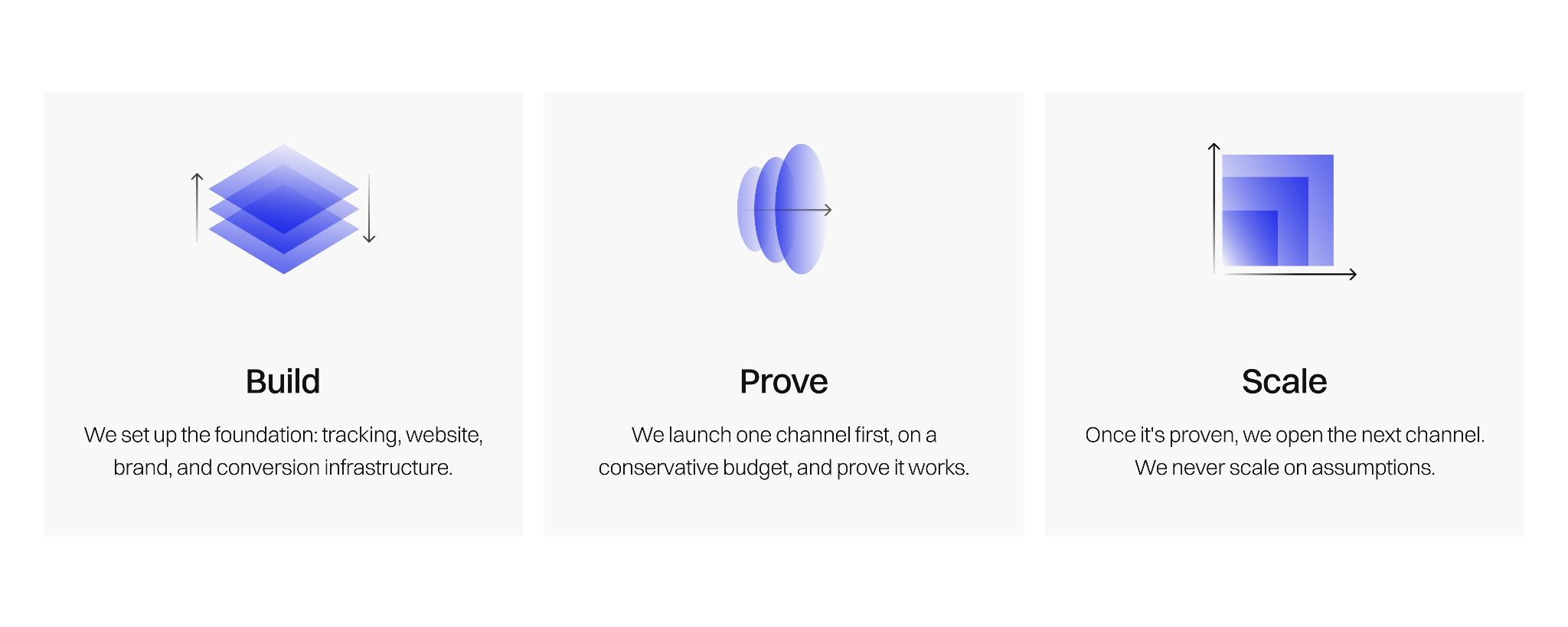
The Build → Prove → Scale marketing framework is an evidence-based approach to growing a startup.
Instead of treating marketing as a series of disconnected campaigns, it follows a structured process that helps founders build strong foundations, validate performance, and expand only when the data supports it.
Rather than asking:
"How can we grow faster?"
The framework encourages founders to ask better questions:
- Are we attracting the right customers?
- Is our positioning clear?
- Does our website convert qualified visitors?
- Can we measure where leads come from?
- Have we proven one acquisition channel before adding another?
- Which marketing activities actually contribute to revenue?
By answering these questions first, startups reduce unnecessary risk and create a marketing system that becomes stronger over time.
The framework is built around three stages:
- Build – Establish the foundations required for sustainable growth.
- Prove – Validate that your marketing consistently produces measurable results.
- Scale – Increase investment only after performance has been demonstrated.
Each stage supports the next, creating a repeatable system instead of relying on isolated marketing wins.
Stage One: Build
Before investing heavily in customer acquisition, startups need the right foundations.
Many founders skip this step because it doesn't produce immediate leads.
However, the quality of your marketing infrastructure has a direct impact on every future campaign.
The Build stage focuses on creating clarity and consistency across your marketing.
This includes:
Positioning
Can your ideal customer immediately understand:
- Who will you help?
- What problem do you solve?
- Why are you different from competitors?
Strong positioning makes every marketing channel more effective because your messaging remains consistent from the first impression through to conversion.
Website Strategy
Your website is more than an online brochure.
It's where prospects decide whether to trust your business.
Whether visitors arrive through SEO, performance advertising, referrals, or email campaigns, your website should guide them towards a clear next step.
During the Build stage, founders should evaluate:
- Value proposition
- Calls to action
- User experience
- Mobile performance
- Conversion paths
- Trust signals
- Lead capture forms
Improving website performance before increasing traffic usually delivers a better return than simply spending more on acquisition.
Marketing Measurement
You can't improve what you don't measure.
Before scaling, founders should establish reliable tracking across the customer journey.
This includes:
- Website analytics
- Conversion tracking
- CRM integration
- Lead source attribution
- Customer Acquisition Cost (CAC)
- Revenue reporting
Without these insights, marketing decisions become educated guesses instead of evidence-based investments.
Lead Generation Foundations
Effective lead generation starts with understanding where your ideal customers spend their time.
Rather than launching multiple acquisition channels at once, identify the channel most likely to reach your audience and build a repeatable process around it.
This focused approach creates a stronger foundation for future growth than trying to be everywhere from day one.
By the end of the Build stage, your startup should have a clear value proposition, a conversion-focused website, reliable measurement, and the infrastructure needed to evaluate marketing performance objectively.
Only then is it time to prove what works.
Stage Two: Prove
Once your marketing foundations are in place, the next step is validation.
This is where many startups go wrong.
They assume that one successful campaign is enough evidence to increase spending. In reality, sustainable growth comes from proving that your marketing can consistently generate qualified leads, not just occasional wins.
The goal of the Prove stage is to answer one simple question:
Can this marketing activity deliver repeatable business results?
Instead of experimenting with multiple channels at once, focus on validating one acquisition channel before expanding. This gives you reliable data, clearer insights, and a stronger foundation for future growth.
During this stage, measure metrics that reflect business performance rather than vanity metrics.
These include:
- Customer Acquisition Cost (CAC)
- Conversion rate
- Qualified leads
- Sales pipeline growth
- Customer Lifetime Value (LTV)
- Return on Marketing Investment (ROMI)
- Revenue attribution
These metrics help founders understand whether marketing is contributing to sustainable growth or simply generating activity.
Validate One Channel Before Expanding
One of the biggest mistakes startups make is trying to grow across every marketing channel at once.
It's common to see businesses investing simultaneously in:
- Google Ads
- LinkedIn Ads
- SEO
- Content marketing
- Email marketing
- Organic social media
- Partnerships
- Events
While each channel has value, spreading limited resources across too many initiatives often leads to inconsistent results.
A better approach is to identify the channel that best matches your Ideal Customer Profile (ICP) and focus on proving its effectiveness first.
For example:
- A B2B SaaS startup may find LinkedIn Ads and SEO deliver the highest-quality leads.
- A founder-led consultancy may generate better results through thought leadership and referrals.
- A product-led business may rely on content marketing and organic search to drive free trial sign-ups.
Once you've demonstrated that one channel consistently delivers qualified leads at an acceptable acquisition cost, you can confidently invest in additional channels.
Build Feedback Loops
Validation isn't just about collecting data. It's about learning from it.
Every campaign should answer questions such as:
- Which messaging resonates most with our audience?
- Which landing pages convert best?
- Where do prospects leave the funnel?
- Which content generates the most qualified enquiries?
- Which traffic sources produce the highest-value customers?
These insights create a continuous feedback loop that improves future marketing decisions.
Instead of relying on assumptions, founders can refine their strategy using real customer behaviour.
Over time, this process leads to stronger messaging, higher conversion rates, and more efficient customer acquisition.
Stage Three: Scale
Only after you've built a solid foundation and proven that your marketing consistently delivers results should you begin scaling.
This is where many founders expect rapid growth, but scaling isn't simply about increasing budget.
It's about expanding what already works.
Scaling may involve:
- Increasing performance advertising spend
- Publishing more SEO-driven content
- Expanding lifecycle marketing campaigns
- Introducing marketing automation
- Testing complementary acquisition channels
- Growing your marketing team
Because these decisions are based on proven performance, they carry significantly less risk than scaling prematurely.
Instead of hoping that more investment will solve marketing problems, you're investing in a system that has already demonstrated its ability to generate results.
Scaling Doesn't Mean Doing More
Many people associate scaling with increasing activity.
In reality, scaling is about increasing efficiency.
A startup that understands its customer journey, tracks attribution accurately, and consistently converts qualified leads will often outperform a business spending twice as much on marketing.
Before increasing budgets, ask yourself:
- Are our conversion rates consistent?
- Can we identify our highest-performing acquisition channel?
- Do we know which marketing activities influence revenue?
- Can our current systems support additional growth?
If the answer is yes, scaling becomes a calculated business decision rather than a gamble.
Common Mistakes Founders Make When Scaling Too Early
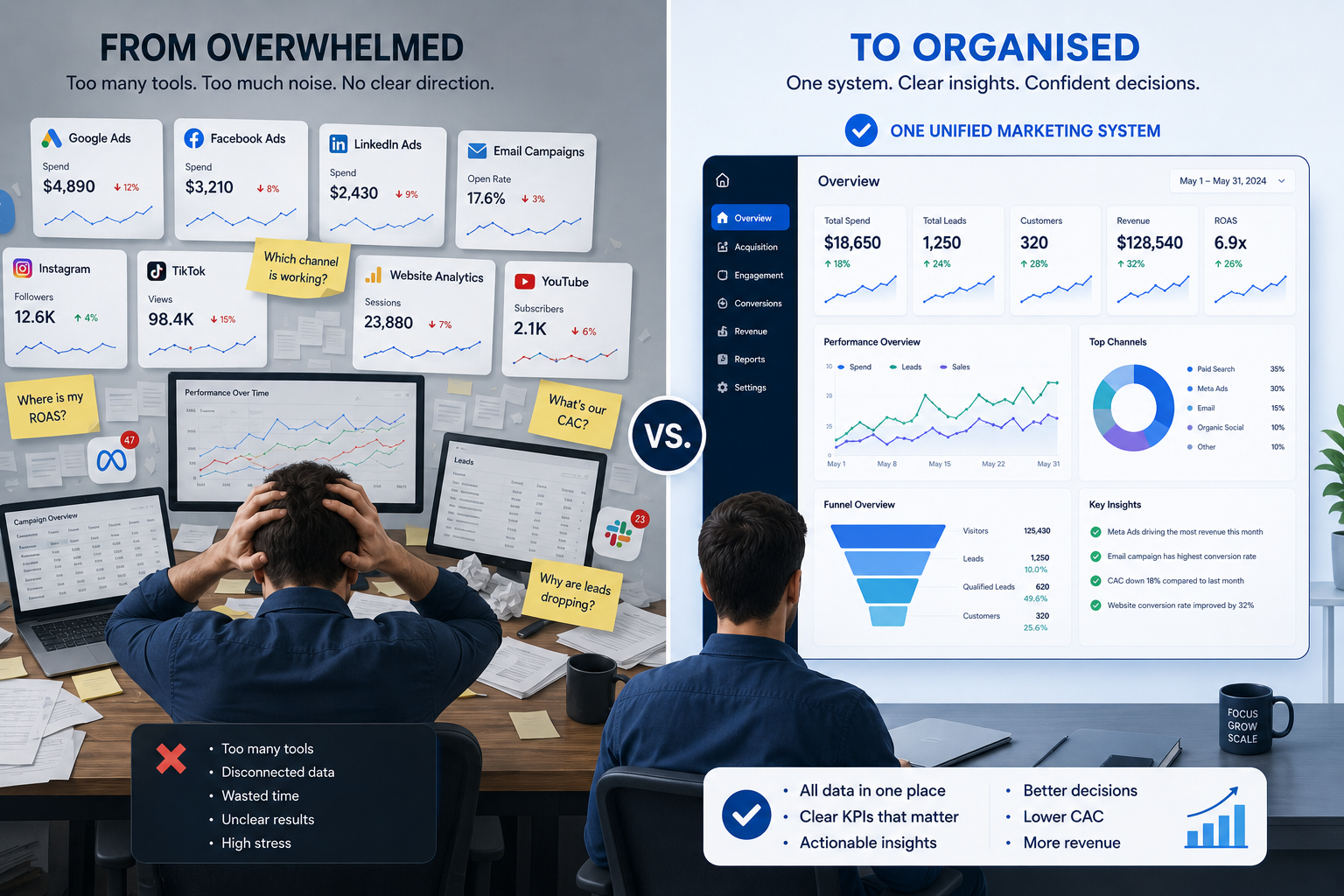
Even experienced founders can fall into the trap of scaling before their marketing is ready.
Recognising these mistakes early can prevent unnecessary spending and help your business grow more sustainably.
Chasing Every New Marketing Trend
New platforms and tactics emerge constantly.
While it's tempting to experiment with every opportunity, switching focus too often prevents startups from mastering the channels that already show promise.
Instead of asking, "What's the latest trend?" ask, "What's already working for our customers?"
Confusing Activity With Progress
Publishing more content, running more ads, or attending more events doesn't necessarily create growth.
Marketing activity only matters when it contributes to meaningful business outcomes.
Focus on metrics such as:
- Qualified leads
- Pipeline growth
- Customer acquisition
- Revenue generated
These indicators provide a far clearer picture of marketing success than impressions or clicks alone.
Ignoring Attribution
If you can't identify where your best customers come from, it's impossible to allocate your budget effectively.
Accurate attribution helps founders understand:
- Which campaigns influence revenue
- Which channels generate the highest-value customers
- Where prospects leave the buying journey
- Which marketing investments deserve additional funding
Without attribution, scaling becomes guesswork.
Expanding Too Many Channels
It's natural to assume that more channels will generate more leads.
However, each new channel introduces additional complexity.
More campaigns require:
- More content
- More reporting
- More optimisation
- More budget
- More internal resources
Successful startups expand gradually, ensuring each new channel complements an already proven acquisition system rather than distracting from it.
Making Decisions Based on Opinions
Every founder has instincts.
Those instincts are valuable, especially during the early stages of building a company.
However, marketing becomes far more effective when decisions are supported by evidence.
Rather than saying:
"I think this campaign worked."
Ask:
- What does the data tell us?
- Which channels generated qualified pipeline?
- Which messaging improved conversions?
- What should we optimise next?
Evidence reduces uncertainty and creates confidence in future investment decisions.
How Corient Applies the Build → Prove → Scale Framework
At Corient, we've seen the same pattern play out across founder-led startups.
Teams invest heavily in marketing before they have the systems to support it. They launch campaigns across multiple channels, hire agencies, and increase budgets, yet qualified pipeline remains inconsistent, and attribution stays unclear.
That's why every engagement starts with one principle:
Don't scale until you've proven what works.
The Corient Method™ follows the Build → Prove → Scale framework to help startups create predictable, measurable growth.
Build
Before generating more demand, we establish the foundations that support sustainable growth.
This includes:
- Defining your Ideal Customer Profile (ICP)
- Clarifying your market positioning
- Creating messaging that resonates with decision-makers
- Optimising your website for conversion
- Implementing analytics and attribution
- Mapping the complete customer journey
Rather than rushing into campaigns, we ensure every marketing activity has a purpose and can be measured.
Prove
Once the foundations are in place, we identify the acquisition channel with the greatest potential.
Instead of spreading the budget across five different tactics, we focus on validating one.
During this stage, we measure business outcomes such as:
- Qualified pipeline
- Customer Acquisition Cost (CAC)
- Revenue attribution
- Conversion rates
- Return on Marketing Investment (ROMI)
The objective isn't simply generating leads.
It's proving that the process can consistently produce commercially valuable opportunities.
Scale
Only after performance is validated do we recommend increasing investment.
Scaling might include:
- Expanding SEO content
- Increasing paid media budgets
- Launching lifecycle marketing campaigns
- Implementing automation
- Adding complementary acquisition channels
Data rather than assumptions support every decision.
The result is a marketing system that becomes more effective over time instead of more expensive.
Why Evidence-Based Marketing Always Wins

Many founders have excellent instincts.
After all, intuition helped build the business in the first place.
However, intuition alone becomes less reliable as marketing becomes more complex.
Evidence-based marketing replaces assumptions with measurable insights.
Instead of asking:
"Should we spend more on ads?"
You ask:
- Which campaigns generate qualified pipeline?
- Which landing pages convert best?
- Which channels produce our highest-value customers?
- Where are prospects dropping out of the buying journey?
These answers allow startups to invest confidently because every decision is backed by performance data.
That's how sustainable growth is built.
Frequently Asked Questions
What is the Build → Prove → Scale framework?
The Build → Prove → Scale framework is a structured marketing methodology that helps businesses establish strong foundations, validate marketing performance, and scale only after results have been consistently proven.
Why shouldn't startups scale marketing immediately?
Scaling too early often increases spending without improving results.
If positioning, conversion, or attribution aren't working, increasing budgets simply amplifies existing problems.
How do you know if a marketing channel is proven?
A marketing channel is considered proven when it consistently generates qualified leads at an acceptable Customer Acquisition Cost (CAC) while contributing measurable revenue over time.
What metrics should founders monitor before scaling?
Key metrics include:
- Customer Acquisition Cost (CAC)
- Conversion rate
- Marketing Qualified Leads (MQLs)
- Sales Qualified Leads (SQLs)
- Revenue attribution
- Return on Marketing Investment (ROMI)
- Customer Lifetime Value (LTV)
Can startups use multiple marketing channels?
Yes, but only after one channel has been validated.
Mastering one acquisition channel before expanding usually delivers stronger results than trying to grow everywhere simultaneously.
Final Thoughts
The startups that scale successfully aren't necessarily the ones spending the most on marketing.
They're the ones making the smartest decisions.
Instead of chasing every new channel or increasing budgets based on optimism, successful founders build systems that create repeatable growth.
The Build → Prove → Scale framework provides a practical roadmap for doing exactly that.
Start by building strong foundations. Prove what works using measurable evidence. Then scale with confidence.
Following this process reduces wasted marketing spend, improves customer acquisition, and creates a marketing engine that becomes more effective over time.
If you're preparing your startup for its next stage of growth, don't guess what's working.
Build a marketing system that proves it.
At Corient, we help founder-led startups replace disconnected campaigns with evidence-based growth systems. Through our Build → Prove → Scale Method™, we help businesses strengthen their foundations, validate performance, and scale with confidence.
Ready to build a marketing system that delivers predictable growth? Contact Corient today to discover how we can help your startup scale with clarity, confidence, and measurable results.
Check out more articles below:
- Founder-Led Marketing: Why Startups Need a Marketing System Instead of Just More Campaigns
- Why Most Startup Marketing Strategies Fail Before They Ever Scale
- What Is a Marketing Operating System? Why Founder-Led Tech Startups Are Moving Beyond Traditional Marketing Agencies
- 10 Signs Your Startup Isn't Ready to Scale Marketing Yet