Launching marketing campaigns is exciting. They promise new leads, more website traffic, and faster business growth. For many founder-led startups, however, the excitement quickly fades when those campaigns fail to deliver lasting results.
It's a familiar story. A founder invests in paid ads, experiments with social media, publishes a few blog posts, or hires a marketing agency, expecting rapid growth. Some campaigns may generate a short-term boost, but after the budget runs out, so do the results. The business finds itself back at square one, searching for the next tactic that might finally work.
The problem isn't necessarily the campaigns themselves. More often, it's the lack of a structured marketing system supporting them.
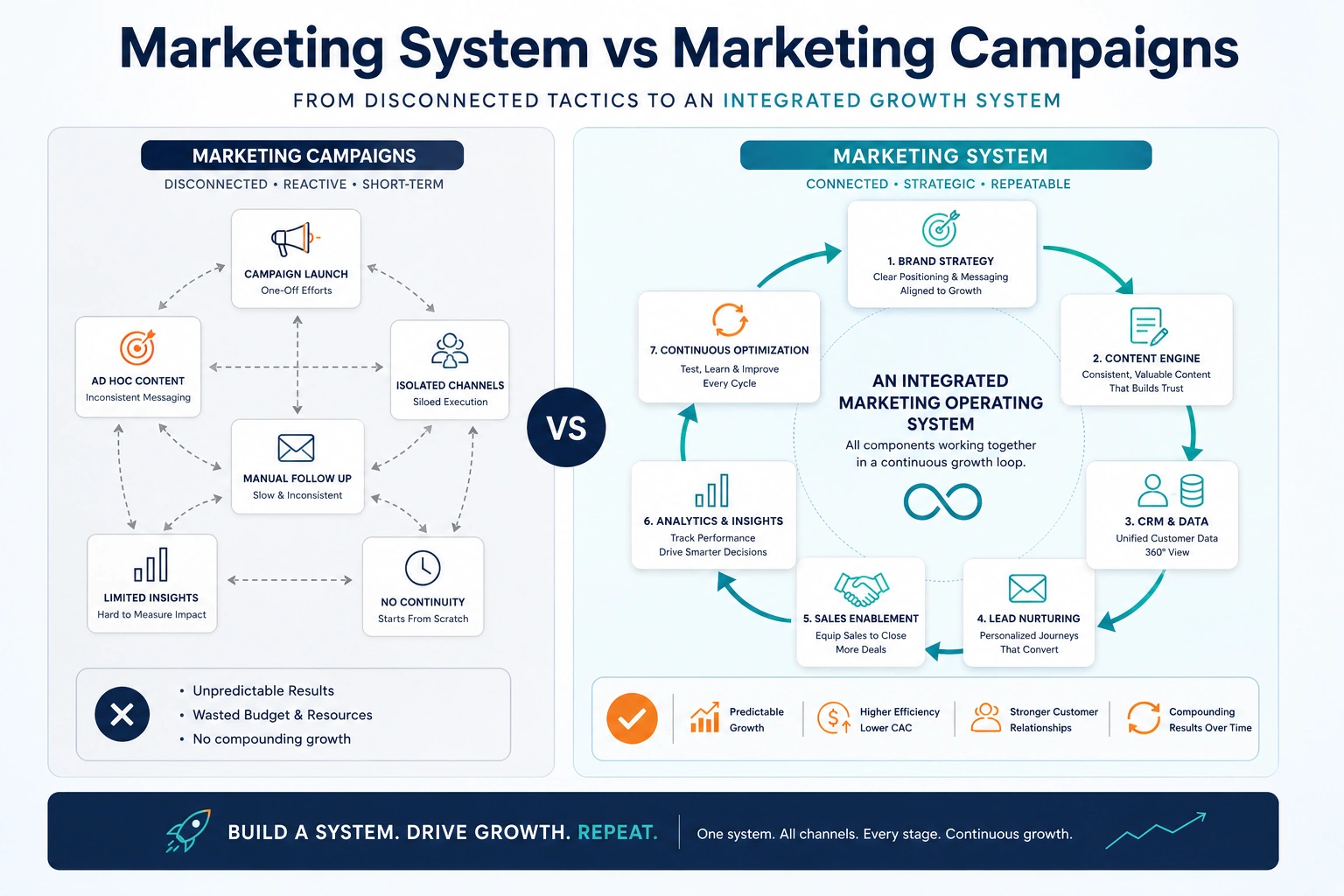
Campaigns are individual activities. A marketing system is the framework that ensures every campaign contributes to long-term, measurable growth. Without that foundation, even well-executed campaigns struggle to create sustainable momentum.
In this guide, you'll learn:
- What founder-led marketing really means,
- Why many startup marketing campaigns fall short, and
- How building a marketing operating system can help founders make smarter decisions, improve customer acquisition, and scale with confidence
What Is Founder-Led Marketing?
Founder-led marketing is a growth approach where the founder remains actively involved in shaping the company's marketing strategy, messaging, and customer relationships.
Unlike larger organisations with multiple marketing departments, founder-led startups rely heavily on the founder's vision, expertise, and direct interaction with customers. The founder often influences everything from brand positioning to product messaging and sales conversations.
This approach offers several advantages:
- Faster decision-making
- Authentic brand communication
- Strong customer relationships
- Clear product-market understanding
- Greater flexibility when testing new ideas
Many successful startups begin this way because founders understand their customers better than anyone else. They know the problems they're solving and can communicate that value authentically.
However, founder-led marketing also presents unique challenges as the business grows.
Characteristics of Founder-Led Startups
Most founder-led startups share several common traits.
The founder wears multiple hats
Marketing is just one responsibility among many. Founders often juggle product development, customer support, hiring, operations, fundraising, and sales, leaving limited time to build a consistent marketing engine.
Resources are limited
Early-stage companies rarely have large marketing teams. Budget constraints mean founders need every marketing dollar to generate measurable results.
Growth depends on speed
Unlike established businesses, startups must learn quickly. Every campaign, landing page, or marketing experiment should generate insights that help improve future decisions.
Every decision carries greater risk
When marketing budgets are limited, ineffective campaigns can delay growth significantly. This makes strategic planning even more important.
Common Growth Challenges Founder-Led Startups Face
Although founder-led businesses often possess deep product knowledge, many struggle to build repeatable marketing processes.
Some of the most common challenges include:
Inconsistent messaging
As products evolve, messaging often changes just as quickly. Without documented positioning, every campaign tells a slightly different story, making it harder for prospects to understand the company's value.
Marketing becomes reactive
Instead of following a long-term strategy, founders frequently chase the latest marketing trend or growth tactic. One month focuses on SEO, the next on paid advertising, then social media, then webinars.
This constant switching prevents any single channel from reaching its full potential.
Limited visibility into performance
Many startups lack accurate attribution. They know leads are arriving, but struggle to identify which marketing activities actually influenced those conversions.
Without reliable tracking, future investment decisions become educated guesses rather than evidence-based choices.
Difficulty scaling
What works for a founder personally doesn't always scale across a growing organisation.
Sales conversations that once relied on the founder's expertise become difficult to replicate through marketing assets alone. Without documented systems, growth eventually reaches a plateau.
Why Most Marketing Campaigns Fail Founder-Led Startups
Marketing campaigns are important, but campaigns alone rarely build sustainable growth.
Many founders assume that increasing advertising spend or launching more campaigns will naturally produce better results. In reality, successful campaigns depend on everything happening behind the scenes.
Without strong positioning, reliable tracking, effective conversion paths, and consistent messaging, campaigns simply amplify existing weaknesses.
Here are four of the biggest reasons startup marketing campaigns fail.
Campaigns Focus on Tactics, Not Systems
A campaign is temporary.
A marketing system is ongoing.
Running a paid advertising campaign may generate website visitors for a few weeks, but if the website isn't converting those visitors into qualified leads, the campaign hasn't solved the underlying problem.
Likewise, publishing blog content without a clear SEO strategy or customer journey often produces isolated results instead of long-term growth.
Successful startups don't view campaigns as isolated projects. Instead, each campaign becomes one component of a larger system designed to improve customer acquisition over time.
Poor Tracking Leads to Poor Decisions
Many founders measure marketing success using surface-level metrics such as:
- Website traffic
- Social media engagement
- Email opens
- Ad impressions
While useful, these metrics don't necessarily indicate business growth.
More meaningful questions include:
- Which channel generated qualified customers?
- What did it cost to acquire each customer?
- Which campaigns produced recurring revenue?
- Which activities influenced conversions?
Without accurate tracking and attribution, marketing decisions become increasingly difficult as budgets grow.
Scaling Before Proving What Works
One of the most expensive mistakes startups make is increasing marketing investment before validating a channel.
For example:
- Increasing advertising spend before understanding customer acquisition costs.
- Expanding into multiple social media platforms before one channel consistently performs.
- Hiring additional marketers before establishing repeatable processes.
Scaling uncertainty only increases costs.
Instead, successful startups validate one marketing channel first, understand its economics, and then gradually expand.
This evidence-first approach reduces risk while improving long-term returns.
Too Many Disconnected Marketing Channels
Many startups attempt to be everywhere at once.
They simultaneously invest in:
- Google Ads
- SEO
- Email marketing
- Podcasts
- Webinars
- Organic social media
- Partnerships
While each channel has potential, managing too many at once often stretches limited resources too thin.
The result is inconsistent execution, fragmented messaging, and incomplete measurement.
A structured marketing system helps founders prioritise the right channels, align them with business goals, and introduce new channels only after existing ones demonstrate consistent performance.
Why a Marketing System Works Better Than Individual Campaigns
Marketing campaigns can generate attention, but a marketing system creates sustainable growth.
Think of a campaign as a single sprint. It has a clear start and finish, whether it's a Google Ads campaign, a product launch, or an email promotion. A marketing system, on the other hand, is the engine that keeps producing results long after individual campaigns end.
For founder-led startups, this distinction is critical. Limited budgets and small teams mean every marketing activity needs to contribute to long-term business growth, not just short-term wins.
A well-designed marketing system connects every part of the customer journey, from attracting prospects to converting them into customers and retaining them over time. Instead of relying on isolated tactics, each marketing effort builds on the last, creating a repeatable process for customer acquisition.
Here's why a marketing system consistently outperforms disconnected campaigns.
Consistent Messaging Builds Trust
One of the biggest challenges for founder-led startups is maintaining consistent messaging.
As products evolve and founders receive customer feedback, messaging often changes rapidly. While iteration is natural, inconsistent communication can confuse prospects.
A marketing system establishes clear positioning before any campaigns begin.
This includes defining:
- Your ideal customer profile
- The core problem your product solves
- Your unique value proposition
- Brand messaging
- Tone of voice
- Key differentiators
With these foundations in place, every marketing channel reinforces the same message.
Whether a prospect discovers your business through Google Search, LinkedIn, a webinar, or an email campaign, they experience a consistent story.
Consistency builds familiarity, and familiarity builds trust.
Reliable Customer Acquisition
Many startups experience unpredictable growth.
One month delivers dozens of qualified leads. The next month, enquiries drop dramatically.
This inconsistency usually happens because marketing depends on individual campaigns rather than a repeatable acquisition process.
A marketing system creates predictable customer acquisition by documenting how prospects move through the buying journey.
Rather than asking, "What campaign should we run next?" founders begin asking:
- Which acquisition channel consistently performs best?
- Where are prospects dropping out?
- Which marketing assets improve conversion rates?
- How can we optimise the customer journey?
Over time, customer acquisition becomes more reliable because decisions are based on data instead of assumptions.
Better Attribution Leads to Better Decisions
One of the biggest advantages of a marketing system is improved visibility.
Without proper attribution, founders often invest more money into activities simply because they appear busy or popular.
A structured marketing system tracks every important interaction, allowing businesses to understand:
- Which channels generate qualified leads
- Which campaigns influence purchasing decisions
- Where prospects abandon the funnel
- Which content contributes to conversions
- Which investments produce the highest return
This level of visibility removes much of the guesswork from marketing.
Instead of relying on intuition, founders can confidently allocate budgets based on measurable performance.
Easier Scaling Without Increasing Complexity
Growth should make marketing more efficient, not more chaotic.
Unfortunately, many startups experience the opposite.
As new channels are introduced, reporting becomes fragmented, messaging becomes inconsistent, and teams struggle to coordinate multiple campaigns.
A marketing system prevents this by introducing structure before expansion.
Instead of launching every possible marketing channel simultaneously, successful startups validate one channel first.
Once that channel consistently delivers measurable results, additional channels can be added without disrupting the existing system.
This creates sustainable growth rather than exponential complexity.
The Core Components of an Effective Startup Marketing System
Every successful marketing system is built on a strong foundation.
While tactics may vary between industries, the underlying components remain remarkably consistent.
Founder-led startups that invest in these fundamentals are better positioned to scale efficiently because each marketing activity supports the next.
Positioning
Everything begins with positioning.
Before spending money on advertising or producing content, founders need absolute clarity on questions such as:
- Who is our ideal customer?
- What problem are we solving?
- Why should customers choose us over competitors?
- What makes our solution different?
Strong positioning simplifies every future marketing decision.
Without it, campaigns often send mixed messages that fail to resonate with the right audience.
Website and Conversion Optimisation
A website should do more than look professional.
It should guide visitors toward meaningful business outcomes.
An effective marketing system treats the website as a conversion asset rather than an online brochure.
This means continually improving:
- Landing pages
- Calls to action
- User experience
- Mobile responsiveness
- Lead capture forms
- Conversion rates
Driving more traffic to a poorly converting website rarely produces sustainable growth.
Improving conversion often generates greater returns than increasing traffic alone.
Tracking and Attribution
You cannot improve what you cannot measure.
Accurate tracking allows founders to understand how customers discover, engage with, and purchase from the business.
A strong measurement framework typically includes:
- Website analytics
- Conversion tracking
- CRM integration
- Marketing attribution
- Customer acquisition cost (CAC)
- Lifetime value (LTV)
Reliable data creates confidence in every future marketing decision.
Customer Journey
Customers rarely purchase immediately after discovering a business.
Instead, they move through several stages before becoming loyal customers.
A marketing system maps this journey carefully, ensuring prospects receive the right information at every stage.
Typical stages include:
- Awareness
- Consideration
- Decision
- Purchase
- Retention
- Advocacy
Understanding this journey helps founders create marketing that supports long-term relationships instead of one-off transactions.
Growth Channels
Channels are the final component, not the first.
Many startups begin by asking which channel they should invest in.
Successful companies first establish their marketing foundations before selecting channels that align with customer behaviour.
Common growth channels include:
- Search Engine Optimisation (SEO)
- Paid Search
- Paid Social
- Email Marketing
- Organic Social Media
- Content Marketing
- Referral Programs
- Partnerships
The goal isn't to use every available channel.
The goal is to identify the few channels that consistently deliver qualified customers and optimise them before expanding further.
How The Corient System™ Helps Founder-Led Startups Grow
Many startups don't fail because they lack marketing ideas. They struggle because there's no structured process for deciding what to build, what to measure, and when to scale.
As the leading B2B Marketing Agency Sydney, Corient is designed to solve that problem by replacing guesswork with a disciplined, evidence-based approach to growth. Rather than chasing every new tactic, we help founder-led startups build a solid marketing foundation, validate what works, and then scale with confidence.
At the heart of the system is a simple principle:
Prove what works before investing more resources into it.
This philosophy is reflected in three stages.
.png)
Build
The Build stage establishes the foundation that every successful marketing effort depends on.
Before launching aggressive customer acquisition campaigns, the focus is on creating the assets and infrastructure needed for long-term growth.
This includes:
- Defining positioning and messaging
- Improving the website for conversions
- Setting up accurate tracking and analytics
- Mapping the customer journey
- Building brand consistency
Without this foundation, even successful campaigns can produce misleading data or poor conversion rates.
Prove
Once the marketing foundation is in place, the next step is validation.
Rather than launching multiple channels at once, the focus shifts to proving that one channel can consistently achieve business goals.
During this phase, founders measure metrics such as:
- Customer acquisition cost (CAC)
- Return on ad spend (ROAS)
- Conversion rates
- Pipeline growth
- Revenue attribution
Only after a channel delivers consistent, measurable performance should additional investment be considered.
This evidence-first approach reduces unnecessary spending while increasing confidence in future decisions.
Scale
Scaling is often where startups make costly mistakes.
Many businesses increase budgets or expand into new channels before understanding why their initial success occurred.
The Scale phase takes a more disciplined approach.
Instead of growing based on optimism, marketing investment grows alongside verified performance.
Once a proven channel consistently delivers results, founders can:
- Increase budgets strategically
- Introduce complementary acquisition channels
- Expand lifecycle marketing
- Invest in automation
- Strengthen customer retention
Because every expansion is supported by reliable data, growth becomes more predictable and sustainable.
Evidence-Based Decision Making
The defining characteristic of The Corient System™ is its emphasis on evidence over assumptions.
Every marketing decision should answer a simple question:
What does the data tell us?
Rather than reacting to trends or opinions, founders evaluate performance using measurable outcomes before deciding where to invest next.
This approach helps reduce wasted spend, improves accountability, and creates a marketing system that becomes stronger over time.
Common Mistakes Founders Make When Managing Marketing

Founder-led startups have a unique advantage: the founder knows the product, customers, and vision better than anyone else. That passion often fuels early growth, but as the business expands, relying solely on instinct becomes increasingly risky.
Many marketing challenges don't arise from a lack of effort; they stem from common mistakes that prevent marketing from becoming a scalable system.
Recognising these mistakes early can help founders build a stronger foundation for sustainable growth.
Treating Marketing as a Series of Campaigns
Many founders think about marketing one campaign at a time.
They launch a paid advertising campaign, run a webinar, publish a few blog posts, or invest in social media. When results slow down, they move on to the next tactic.
While campaigns can generate short-term wins, they rarely create predictable growth on their own.
A better approach is to ask:
- How does this campaign fit into our overall customer journey?
- What happens after someone becomes a lead?
- How will we measure success?
- What have we learned that can improve future campaigns?
Every campaign should strengthen the marketing system rather than exist as an isolated activity.
Chasing Every New Marketing Trend
Marketing trends change constantly.
One month, it's AI-generated content. Next, it's a short-form video or a new advertising platform.
Trying every new tactic often leads to scattered execution and inconsistent results.
Successful founders focus less on trends and more on solving customer problems. They evaluate new opportunities carefully, introducing them only when they support an existing marketing strategy.
Ignoring Data in Favour of Opinions
It's easy to assume you know what's working.
After all, founders speak with customers regularly and understand their business deeply.
However, assumptions can become expensive as marketing budgets increase.
Instead of asking:
"I think this campaign worked."
Ask:
- What does the conversion data show?
- Which channel produced qualified customers?
- Has customer acquisition become more efficient?
- Are we improving profitability?
Evidence should guide marketing decisions, not opinions.
Expanding Too Quickly
Growth often creates excitement.
After seeing success in one channel, founders sometimes launch several more at the same time.
Unfortunately, this often introduces unnecessary complexity.
Each new channel requires:
- New creative assets
- Additional reporting
- More optimisation
- Consistent messaging
- Ongoing management
Expanding gradually allows businesses to maintain quality while preserving visibility into performance.
Failing to Document Processes
Many founder-led startups rely heavily on knowledge that exists only in the founder's head.
Sales messaging.
Customer objections.
Brand positioning.
Marketing priorities.
Without documentation, scaling becomes difficult because new team members must rely on verbal explanations instead of repeatable systems.
Documented marketing processes improve consistency, onboarding, and long-term efficiency.
How to Know If Your Startup Needs a Marketing System
Not every startup requires a sophisticated marketing operation from day one.
However, there comes a point when informal marketing efforts begin to limit growth.
Here are some signs your business may be ready for a structured marketing system.
Your Growth Depends on Constant Founder Involvement
If every sale depends on the founder personally explaining the product, marketing isn't yet scalable.
A strong marketing system captures that expertise and communicates it consistently through websites, content, email marketing, and sales assets.
Marketing Results Are Unpredictable
Some months generate excellent results.
Others produce very little.
Large swings in performance often indicate that marketing depends on isolated campaigns instead of repeatable systems.
You Can't Clearly Explain Where Customers Come From
If someone asks:
"Which marketing channel produces your highest-quality customers?"
Could you answer confidently?
Without reliable attribution, founders often invest in the wrong activities simply because they appear successful.
Every New Campaign Starts From Scratch
If your team recreates messaging, landing pages, or reporting every time a campaign launches, valuable time is being lost.
Marketing systems standardise these processes, allowing teams to execute more efficiently.
You're Ready to Scale, but Unsure How
Perhaps your product has found market fit.
Revenue is growing.
Customer demand is increasing.
Yet you're uncertain whether increasing marketing spend will produce profitable growth.
This is often the ideal time to introduce a structured marketing system that provides confidence before scaling investment.
Frequently Asked Questions
What is founder-led marketing?
Founder-led marketing is an approach where the founder plays a central role in shaping the company's marketing strategy, messaging, and customer relationships. It often works well in startups because founders possess deep product knowledge and direct customer insight.
Why do startups struggle with marketing?
Many startups focus on individual campaigns without first building the systems needed to support sustainable growth. Weak positioning, inconsistent messaging, poor tracking, and unclear customer journeys can all reduce marketing effectiveness.
What is a marketing operating system?
A marketing operating system is a structured framework that connects strategy, positioning, customer acquisition, measurement, and optimisation into one repeatable process. Rather than relying on isolated campaigns, it helps businesses build predictable and scalable marketing.
When should startups invest in marketing systems?
Startups should consider implementing a marketing system once they have achieved product-market fit and are preparing to scale customer acquisition. Establishing strong foundations early often reduces wasted marketing spend and supports more sustainable growth.
Final Thoughts
Founder-led startups have a significant advantage: they understand their customers, products, and vision better than anyone else.
However, sustainable growth requires more than great ideas or successful campaigns.
It requires a marketing system.
Instead of constantly searching for the next tactic, founders who invest in positioning, measurement, customer journeys, and evidence-based decision-making create marketing that improves over time.
Campaigns become more effective because they operate within a structured framework rather than in isolation.
As your startup grows, marketing should become increasingly predictable, not increasingly complicated.
Building a system today creates the foundation for smarter decisions, better customer acquisition, and long-term, scalable growth.
Ready To Build A Marketing System That Grows With Your Business?
At Corient, we help founder-led startups replace disconnected campaigns with an evidence-based marketing operating system designed to deliver measurable growth. From refining your positioning and improving conversions to validating acquisition channels and scaling with confidence, our Build → Prove → Scale methodology helps you make every marketing decision count.
Get in touch with Corient to discover how a structured marketing system can help your startup grow more predictably and profitably.
Check out more articles below:
- Salesforce Marketing Cloud vs HubSpot: Which CRM Wins in 2026?
- How to Set Up Lead Scoring in Salesforce (Step-by-Step Guide)
- CRM Data Hygiene: The 2026 Playbook for Clean, Actionable Data
- CRM Mistakes That Are Costing You Leads (And How to Fix Them)