Growing a startup isn't just about generating more leads.
It's about building a predictable system that consistently turns marketing investment into qualified pipeline, customers, and revenue.
For many founder-led tech startups, that's where traditional marketing agencies begin to fall short.
An agency might deliver an excellent Google Ads campaign, redesign your website, improve your SEO rankings, or launch an email campaign. Individually, those services can create value. But when they're delivered as disconnected projects, they rarely solve the bigger challenge founders face: creating a repeatable customer acquisition engine that scales with the business.
The result is familiar.
Marketing activity increases, but the pipeline remains inconsistent.
Advertising spend rises, yet Customer Acquisition Cost (CAC) becomes harder to justify.
Multiple platforms generate reports, but founders still can't confidently answer one critical question:
What's actually driving revenue?
This is why more founder-led startups are moving away from campaign-based marketing and towards a marketing operating system.
Rather than treating marketing as a collection of isolated tactics, a marketing operating system connects strategy, lead generation, website performance, conversion optimisation, lifecycle marketing, attribution, and performance advertising into one measurable framework.
Instead of simply running campaigns, it builds an acquisition system that becomes more effective over time.
At Corient, this philosophy forms the foundation of The Corient Method™; our evidence-based approach that helps founder-led startups Build → Prove → Scale through measurable growth rather than marketing guesswork.
In this guide, you'll learn:
- What a marketing operating system is
- Why founder-led tech startups are moving beyond traditional agencies
- How a marketing operating system creates a predictable pipeline
- The essential components every growth system needs
- Why evidence, not assumptions, should determine when you scale
What Is a Marketing Operating System?
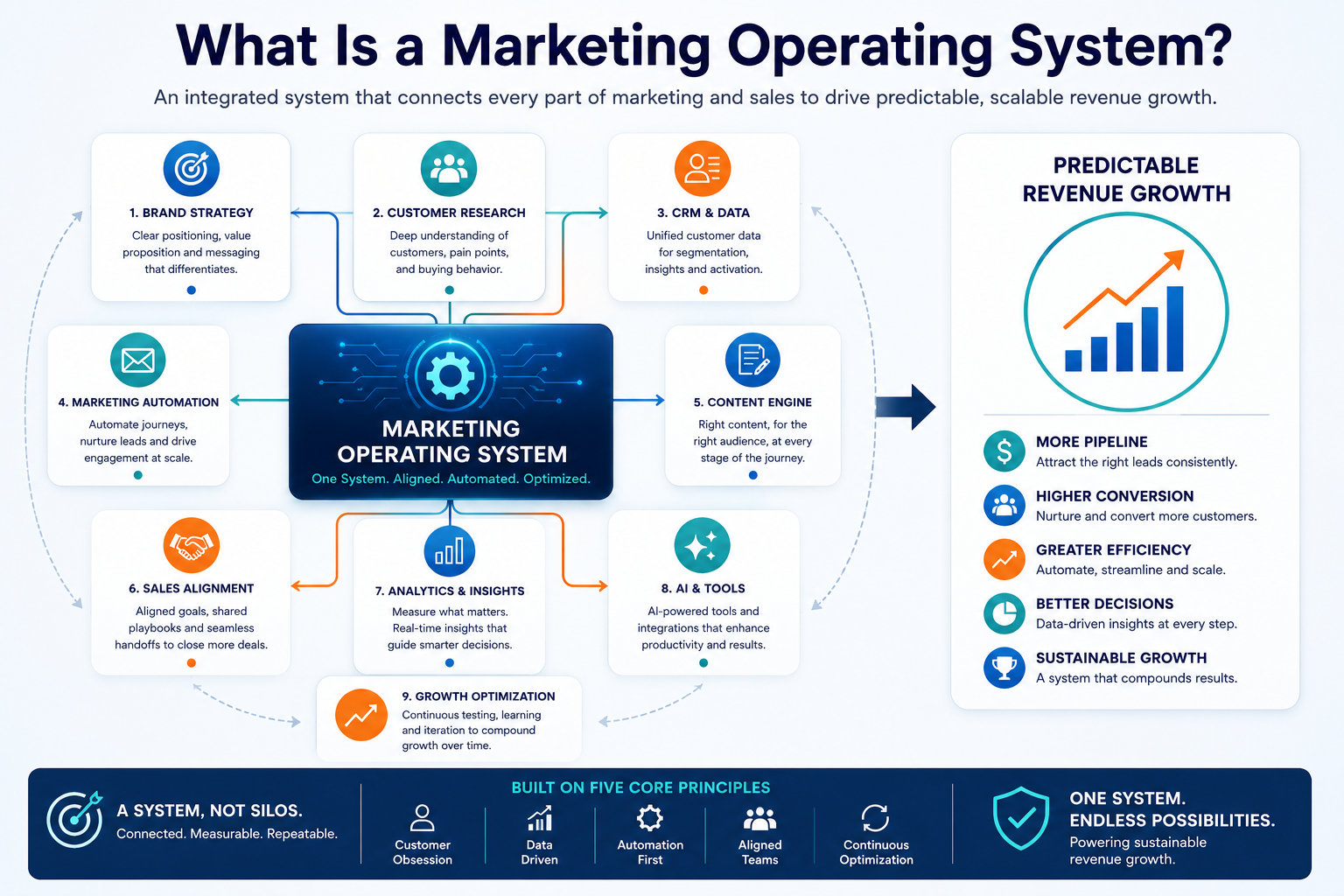
A marketing operating system is a structured growth framework that aligns every marketing activity around one objective:
Generating predictable, measurable customer acquisition.
Unlike a traditional agency model, where services are often delivered independently, a marketing operating system connects every stage of the customer journey into a single, continuously improving system.
Rather than asking:
"What campaign should we launch next?"
Founder-led startups begin asking more strategic questions.
- Are we attracting our Ideal Customer Profile?
- Which channels generate Sales Qualified Leads (SQLs)?
- Where are prospects dropping out of the funnel?
- Is our Customer Acquisition Cost commercially sustainable?
- Which improvements will create the biggest impact on the pipeline?
- Do we have enough evidence to increase investment?
Those questions fundamentally change how marketing decisions are made.
Instead of reacting to trends or chasing the next growth hack, founders gain a framework for making evidence-based investment decisions.
Think of it as the operating system behind your growth.
Just as an operating system allows every application on a computer to work together, a marketing operating system connects:
- Positioning
- Website strategy
- Lead generation systems
- Performance advertising
- SEO
- Lifecycle marketing
- CRM
- Analytics
- Attribution
- Conversion optimisation
Each element strengthens the others.
Nothing operates in isolation.
The result is a marketing function that becomes more predictable, accountable, and scalable.
Why Founder-Led Tech Startups Outgrow Traditional Marketing Agencies
Most founder-led startups hire agencies because they need expertise they don't yet have in-house.
- An agency might manage Google Ads.
- Another writes SEO content.
- A freelance designer rebuilds the website.
- Someone else implements email automation.
Individually, each partner may perform well. Collectively, however, the marketing ecosystem often becomes fragmented. Different teams optimise different metrics. Different platforms produce different reports.
Messaging changes between campaigns. Attribution becomes unclear.
And founders are left trying to determine which activities are actually creating revenue.
This problem becomes more pronounced as startups move from early traction to scalable growth.
At the seed stage, a few successful campaigns may generate enough momentum.
By Series A, however, investors expect a predictable pipeline, efficient customer acquisition, and measurable commercial outcomes.
That requires far more than tactical execution.
It requires an operating system.
Rather than outsourcing individual marketing activities, founder-led startups increasingly need:
- A unified acquisition strategy
- Shared commercial metrics
- Connected reporting
- Reliable attribution
- Integrated customer journeys
- Continuous optimisation
This shift transforms marketing from a collection of services into a business capability.
Instead of asking whether an SEO campaign performed well, founders begin asking whether their lead generation system is producing a sustainable pipeline.
Instead of reviewing advertising metrics in isolation, they evaluate how performance advertising contributes to revenue.
Instead of treating the website as a digital brochure, they view it as a conversion engine.
This systems-thinking approach enables startups to scale with significantly greater confidence.
Marketing Agency vs Marketing Operating System
At first glance, both approaches are trying to achieve the same outcome: business growth.
However, they take very different paths to get there.
A traditional marketing agency is typically focused on delivering marketing activities and campaigns. A marketing operating system is designed to build a repeatable, measurable client acquisition engine that becomes more effective over time.
Here's how they differ.
Strategic Focus
Traditional Marketing Agency
- Focuses on executing individual marketing campaigns.
- Strategy is often centred around specific channels such as SEO, paid advertising, or social media.
- Success is measured by campaign delivery and channel performance.
Marketing Operating System
- Builds a unified commercial growth strategy aligned with business objectives.
- Every marketing activity supports a connected acquisition system.
- Success is measured by predictable business growth and revenue outcomes.
Lead Generation & Customer Journey
Traditional Marketing Agency
- Generates leads through individual campaigns.
- Website, advertising, and email marketing often operate independently.
- Customer journey can become fragmented.
Marketing Operating System
- Creates connected lead generation systems.
- Treats the website as a conversion-focused growth asset rather than a standalone project.
- Integrates performance advertising, lifecycle marketing, and conversion optimisation into one continuous customer journey.
Measurement & Optimisation
Traditional Marketing Agency
- Reports on channel-specific metrics such as impressions, clicks, and traffic.
- Attribution is often incomplete.
- Growth usually comes from increasing marketing activity or budget.
Marketing Operating System
- Measures commercial KPIs such as revenue, Customer Acquisition Cost (CAC), Sales Qualified Leads (SQLs), pipeline value, and conversion rates.
- Uses full-funnel attribution to understand what drives revenue.
- Scales only after campaigns and systems have been validated with real performance data.
| Area | Traditional Marketing Agency | Marketing Operating System |
|---|---|---|
| Primary Objective | Execute campaigns | Build a predictable pipeline |
| Strategy | Often channel-specific | Unified commercial growth strategy |
| Lead Generation | Individual campaigns | Connected lead generation systems |
| Website | Standalone project | Conversion-focused growth asset |
| Performance Advertising | Campaign management | Acquisition optimisation |
| Lifecycle Marketing | Often separate | Integrated into the customer journey |
| Reporting | Channel metrics | Revenue, CAC, SQLs, and pipeline |
| Attribution | Partial visibility | Full-funnel attribution |
| Scaling | Increase activity | Scale only after validation |
| Success Metric | Campaign delivery | Commercial growth outcomes |
The difference is simple. Agencies often optimise marketing activities. A marketing operating system optimises the entire growth engine, ensuring every investment contributes to predictable, scalable business growth.
Why Founder-Led Startups Need More Than Campaigns
Founder-led tech businesses don't usually fail because they lack marketing activity.
They fail because marketing isn't operating as a system.
One agency increases website traffic.
Another improves paid media performance.
Internal teams create content.
Sales builds outbound campaigns.
Customer success manages onboarding.
Each function performs useful work.
But if those activities aren't connected, founders encounter familiar problems:
- Rising CAC
- Inconsistent demo bookings
- Low trial-to-paid conversion
- Conflicting reports
- Unclear attribution
- Unpredictable pipeline
The issue isn't effort.
It's integration.
A marketing operating system solves this by ensuring every component of the customer acquisition journey supports the same commercial objective.
Rather than asking:
"How do we generate more traffic?"
Founders begin asking:
"How do we generate a more qualified pipeline?"
That subtle shift changes every subsequent marketing decision.
Instead of optimising channels independently, businesses optimise the entire acquisition system.
This philosophy sits at the heart of The Corient Method™.
Rather than adding more activity, we help founder-led startups build systems that improve with every campaign.
Why Predictable Pipeline Beats More Marketing Activity
Many startups mistakenly believe growth requires doing more.
More advertising.
More SEO.
More email campaigns.
More agencies.
In reality, sustainable growth comes from making each marketing activity work together.
For example:
A founder discovers your business through an educational SEO article.
They download a resource.
Lifecycle marketing nurtures the relationship.
Performance advertising keeps your brand visible.
A conversion-focused website encourages a demo booking.
CRM automation routes the opportunity to sales.
Attribution identifies exactly which touchpoints influenced revenue.
That's not a campaign.
That's a growth system.
And that's precisely why founder-led startups increasingly adopt marketing operating systems instead of relying solely on traditional agency services.
The Core Components of a Marketing Operating System

A marketing operating system isn't another marketing platform or software subscription.
It's the framework that connects every part of your customer acquisition process into one measurable growth engine.
For founder-led tech startups, that means every marketing investment, from SEO to paid advertising, works towards the same commercial objective: generating a predictable pipeline.
When one component is weak, the entire system suffers.
For example:
- Performance advertising without conversion optimisation increases Customer Acquisition Cost (CAC).
- SEO without clear positioning attracts the wrong audience.
- A high-performing website without lifecycle marketing loses potential customers before they activate.
- Strong lead generation without attribution makes scaling impossible.
A marketing operating system solves these problems by ensuring every element works together instead of competing for attention.
At Corient, these components form the foundation of The Corient Method™, allowing founders to build marketing systems that become more effective with every campaign.
Positioning: The Foundation of Predictable Growth
Before launching campaigns or increasing advertising budgets, founders need one thing above all else:
Clarity.
Positioning determines how your business is understood by the market.
It answers questions such as:
- Who is your Ideal Customer Profile (ICP)?
- What business problem do you solve?
- Why should prospects choose you instead of a competitor?
- What makes your solution different?
- Why should they act now?
Without clear positioning, every marketing channel tells a slightly different story.
Your Google Ads promise one thing.
Your website communicates another.
Sales pitches something else entirely.
The result is confusion, lower conversion rates, and rising acquisition costs.
For founder-led startups, positioning becomes even more important because the founder is often still the face of the business.
Customers buy confidence before they buy software.
A strong marketing operating system ensures that every touchpoint reinforces the same value proposition, from SEO articles to paid ads, demo pages, and lifecycle emails.
Website Strategy: Your Highest-Performing Sales Asset
Many startups treat their website as a design project.
High-growth companies treat it as their most important sales asset.
Every marketing channel ultimately sends prospects to your website.
Whether someone discovers your business through:
- Google Search
- LinkedIn Ads
- Performance advertising
- Email campaigns
- Referrals
- Organic content
The website determines whether that attention turns into a qualified pipeline.
A high-performing website should do far more than explain what your company does.
It should:
- Communicate your value proposition immediately.
- Guide visitors towards the next step.
- Build trust through proof and credibility.
- Capture qualified leads.
- Reduce friction throughout the buying journey.
- Support attribution and conversion measurement.
For SaaS and technology businesses, this often means optimising pages for:
- Demo bookings
- Free-trial registrations
- Product sign-ups
- Enterprise enquiries
- Sales consultations
Within The Corient Method™, website strategy isn't treated as a one-off project.
It's continually refined through testing, behavioural insights, and conversion optimisation to improve pipeline generation over time.
Lead Generation Systems: Building Predictable Pipeline
Many founders believe they have a lead generation problem.
In reality, they usually have a system problem.
Generating leads isn't difficult.
Generating the right leads consistently is.
A marketing operating system replaces isolated campaigns with an integrated lead generation system where every acquisition channel supports the next.
Rather than relying on a single source of traffic, successful startups build multiple connected pathways that attract qualified prospects.
These might include:
- Search engine optimisation (SEO)
- Performance advertising
- Founder-led thought leadership
- Educational content
- Referral programs
- Strategic partnerships
- Lifecycle email campaigns
Each channel serves a specific purpose.
SEO captures high-intent search demand.
Performance advertising accelerates visibility among ideal customers.
Educational content builds trust before prospects are ready to buy.
Lifecycle marketing nurtures relationships until prospects become sales-ready.
Instead of competing for attention, these channels reinforce one another.
The result is a lead generation system capable of producing predictable pipelines instead of unpredictable spikes in activity.
Performance Advertising: Accelerating Proven Demand
Performance advertising remains one of the fastest ways for startups to generate awareness and validate customer demand.
But spending more isn't the same as growing faster.
Many founders increase advertising budgets before they've established:
- Clear positioning
- Strong landing pages
- Accurate tracking
- Effective conversion paths
When these foundations are missing, advertising simply amplifies inefficiencies.
Higher spending often produces:
- Rising Customer Acquisition Cost (CAC)
- Lower return on ad spend
- Poor-quality leads
- Wasted budget
Within a marketing operating system, performance advertising serves a different role.
It's used to answer commercial questions such as:
- Which messaging resonates most with our Ideal Customer Profile?
- Which audience segments convert most efficiently?
- Which offers increase demo bookings?
- Which campaigns contribute to the pipeline?
Advertising becomes a testing environment, not merely a traffic source.
Only after campaigns consistently generate profitable customer acquisition does additional investment become justified.
This disciplined approach aligns closely with The Evidence Gate™, where Corient validates performance before recommending scale.
SEO: A Demand Generation Engine, Not Just a Ranking Strategy
Many agencies measure SEO success by rankings.
Founder-led startups should measure it by pipeline.
Search visibility has value only when it attracts the right audience and moves them closer to becoming customers.
A marketing operating system approaches SEO as a long-term demand generation strategy.
Rather than publishing disconnected blog posts, content is organised around topical authority and customer intent.
This includes creating content that supports every stage of the buying journey, from awareness through to evaluation and decision-making.
For example, a founder researching growth challenges may first discover an educational article.
From there, they explore related resources on lead generation systems, website strategy, lifecycle marketing, or performance advertising before requesting a consultation.
Each piece of content strengthens the next through strategic internal linking and consistent messaging.
Over time, this creates a compounding asset that continues attracting qualified traffic long after publication.
For founder-led tech startups, SEO becomes far more than a channel; it becomes a scalable source of demand.
Lifecycle Marketing: Turning Leads into Revenue
Generating leads is only the beginning.
Many startups lose potential customers after the first interaction because they lack a structured follow-up process.
This is where lifecycle marketing becomes essential.
Rather than treating conversion as a single event, lifecycle marketing supports prospects throughout their entire journey.
This might include:
- Welcome email sequences
- Product education
- Trial onboarding
- Behaviour-based automation
- Customer nurturing
- Upsell campaigns
- Re-engagement workflows
- Referral initiatives
For SaaS businesses, improving lifecycle marketing often has a greater commercial impact than increasing advertising spend.
Small improvements in trial activation, onboarding, or customer retention can significantly increase Customer Lifetime Value (LTV) while reducing reliance on constant new customer acquisition.
Within a marketing operating system, lifecycle marketing ensures every lead has the best possible opportunity to become long-term revenue.
Conversion Optimisation: Making Every Visitor More Valuable
One of the most overlooked growth opportunities isn't attracting more visitors.
It's converting more of the visitors you already have.
Conversion optimisation focuses on reducing friction throughout the buying journey.
That may involve improving:
- Landing page messaging
- Calls to action
- Demo booking flows
- Free-trial registration
- Mobile usability
- Site speed
- Trust signals
- Social proof
For founder-led startups with limited marketing budgets, increasing conversion rates often delivers a greater return than increasing advertising spend.
When conversion improves, every acquisition channel becomes more efficient.
SEO produces more leads.
Paid advertising becomes more profitable.
Lifecycle campaigns perform better.
Pipeline grows without proportionally increasing investment.
That's why conversion optimisation is treated as an ongoing discipline, not a one-time project, within The Corient Method™.
Attribution: The Difference Between Guessing and Scaling
Perhaps the most valuable component of a marketing operating system is attribution.
Without it, founders are forced to make investment decisions based on assumptions.
Accurate attribution answers questions such as:
- Which marketing channels generate Sales Qualified Leads?
- Which campaigns influence revenue?
- Where are prospects dropping out?
- Which content contributes to demo bookings?
- Which acquisition sources produce the healthiest CAC?
Instead of reviewing isolated channel reports, founders gain a complete picture of the customer journey.
This visibility creates confidence.
Budgets become easier to allocate.
Experiments become easier to evaluate.
Growth becomes easier to predict.
During the Build phase, Corient establishes this measurement framework early so founders can make informed decisions based on evidence rather than opinion.
Automation: Scaling Without Adding Complexity
Growth inevitably creates complexity.
More leads.
More campaigns.
More touchpoints.
More reporting.
Trying to manage this manually quickly becomes unsustainable.
Automation allows startups to scale without sacrificing consistency.
Within a marketing operating system, automation supports activities such as:
- Lead routing
- CRM updates
- Lifecycle email sequences
- Customer onboarding
- Sales notifications
- Reporting dashboards
- Internal workflows
Importantly, automation doesn't replace strategy.
It strengthens proven processes by making them repeatable.
Rather than relying on manual execution, founders gain a scalable operating model that supports continued growth while freeing internal teams to focus on higher-value work.
Why Founder-Led Tech Startups Benefit Most from a Marketing Operating System
As a founder, you're often the person approving marketing budgets, reviewing campaign reports, and ultimately answering to investors or your board for growth outcomes.
That makes marketing decisions highly consequential.
Every dollar spent on acquisition needs to contribute to a qualified pipeline, not just website traffic or engagement metrics.
This is where a marketing operating system creates a significant competitive advantage.
Instead of relying on disconnected campaigns, founder-led startups build a framework that supports consistent, measurable growth.
Marketing Becomes a Business Function, Not a Collection of Channels
Many startups reach a stage where marketing becomes increasingly fragmented.
SEO is managed by one provider.
Paid advertising by another.
Email marketing sits on a different platform.
Website updates happen when time allows.
CRM data is incomplete.
Each initiative may perform reasonably well on its own, but founders still struggle to answer a simple question:
What's actually driving revenue?
A marketing operating system connects these functions into one cohesive growth engine.
Rather than managing channels separately, founders gain visibility into how every activity contributes to pipeline generation and customer acquisition.
Better Use of Limited Marketing Budgets
Most founder-led startups don't have unlimited resources.
Marketing investment needs to be efficient.
Instead of spreading budget across multiple untested channels, a marketing operating system prioritises activities that have already demonstrated commercial value.
This reduces wasted spend while improving:
- Customer Acquisition Cost (CAC)
- Marketing efficiency
- Sales Qualified Leads (SQLs)
- Pipeline quality
- Return on Marketing Investment (ROMI)
Rather than guessing where the next opportunity lies, founders invest based on evidence.
Better Alignment Between Sales and Marketing
One of the biggest causes of stalled growth is poor alignment between marketing and sales.
Marketing celebrates lead volume.
Sales complains about lead quality.
Leadership sees inconsistent revenue forecasts.
A marketing operating system solves this by giving every team the same objectives.
Instead of optimising individual metrics, everyone focuses on shared commercial outcomes such as:
- Qualified pipeline
- Demo bookings
- Trial activation
- Customer Acquisition Cost
- Revenue attribution
- Customer Lifetime Value (LTV)
When everyone measures success the same way, decision-making becomes faster and more effective.
Growth Becomes Predictable
The biggest benefit isn't simply generating more leads.
It's reducing uncertainty.
Predictable growth allows founders to:
- Forecast revenue with greater confidence.
- Allocate marketing budgets more effectively.
- Expand into new acquisition channels strategically.
- Hire with confidence.
- Report meaningful growth metrics to investors.
This shift from reactive marketing to predictable acquisition is what distinguishes high-performing founder-led startups from those constantly chasing the next campaign.
Signs You're Using an Agency Instead of a Growth System
Many agencies deliver excellent work.
The issue isn't execution.
The issue is whether that execution contributes to a connected growth strategy.
Here are several warning signs that your marketing is operating as a collection of services rather than a true marketing operating system.
Every Campaign Starts from Scratch
If every new campaign requires rebuilding messaging, landing pages, reporting, and tracking, your business lacks repeatable systems.
Growth should become easier over time, not harder.
You're Receiving Reports, but Not Commercial Insights
Most agencies report:
- Clicks
- Impressions
- Traffic
- Cost per click
- Rankings
Those metrics have value.
But founders usually care more about questions like:
- Which campaigns generated pipeline?
- Which channels created SQLs?
- What's our CAC?
- Which acquisition source delivers the strongest ROI?
- Where should we invest next?
A marketing operating system answers those questions.
Your Website Isn't Supporting Growth
Your website shouldn't function as an online brochure.
It should actively generate commercial outcomes.
If your website isn't consistently producing:
- Demo bookings
- Qualified enquiries
- Product trials
- Sales conversations
…then it isn't functioning as part of your acquisition system.
Website strategy should evolve continuously based on user behaviour, conversion data, and customer feedback.
Marketing Decisions Are Based on Opinions
Statements like:
"Let's try TikTok."
"Our competitor is running Meta Ads."
"We should probably spend more."
Are usually signs that decisions are being made without evidence.
Within a marketing operating system, investment decisions are based on measurable commercial performance, not assumptions.
Pipeline Is Still Unpredictable
Perhaps the clearest warning sign is an inconsistent pipeline.
If some months produce excellent results while others fall dramatically, the issue is rarely effort.
It's usually a lack of systems.
Predictable acquisition requires predictable processes.
How The Corient Method™ Works

At Corient, we believe founder-led startups don't need more marketing activity.
They need a better operating model.
That's why we've developed The Corient Method™, an evidence-based marketing operating system designed specifically for Australian founder-led technology companies.
Rather than treating marketing as isolated campaigns, The Corient Method™ builds a connected acquisition engine that grows stronger over time.
The framework follows three stages.
Build
Growth starts with infrastructure.
Before increasing acquisition budgets, we establish the foundations required for sustainable performance.
This includes:
- Positioning
- Website strategy
- Lead generation systems
- Conversion optimisation
- Lifecycle marketing
- CRM alignment
- Attribution
- Reporting
- Performance measurement
A key part of this stage is the Pilot campaign. Where it's included in your scope, a campaign with a lead form goes live within 30 days while the full build runs over 8 weeks.
Alongside it, the build rapidly establishes tracking, attribution, and baseline performance metrics so founders can quickly identify where opportunities and constraints exist across the customer journey.
Instead of waiting months for clarity, founders gain actionable growth signals early.
Prove
Once the foundations exist, we validate performance.
Rather than launching every acquisition channel simultaneously, we identify the highest-potential opportunities and measure their commercial impact.
Performance is evaluated using metrics such as:
- Customer Acquisition Cost (CAC)
- Sales Qualified Leads (SQLs)
- Pipeline contribution
- Demo bookings
- Trial activation
- Revenue attribution
- Return on Marketing Investment (ROMI)
Before recommending further investment, every initiative passes through The Evidence Gate™.
The Evidence Gate™ ensures scaling decisions are based on repeatable commercial outcomes, not optimism.
Scale
Only after a marketing system consistently produces predictable results do we recommend expansion.
Scaling may involve:
- Increasing performance advertising budgets
- Expanding SEO topic clusters
- Strengthening lifecycle marketing
- Improving website conversion
- Automating customer journeys
- Launching complementary acquisition channels
Because every decision builds on validated success, growth becomes more predictable, efficient, and commercially accountable.
Frequently Asked Questions
What is a marketing operating system?
A marketing operating system is a structured framework that connects positioning, website strategy, lead generation, performance advertising, lifecycle marketing, attribution, reporting, and optimisation into one repeatable customer acquisition system.
Is a marketing operating system different from a marketing agency?
Yes.
A traditional agency typically delivers individual marketing services.
A marketing operating system provides the strategic framework that aligns those services around measurable business outcomes like pipeline, customer acquisition, and revenue growth.
Who benefits most from a marketing operating system?
Marketing operating systems are particularly valuable for founder-led B2B and B2C tech startups, SaaS businesses, and high-growth companies preparing to scale from seed stage through Series A and beyond.
Why is attribution so important?
Without attribution, founders can't confidently identify which marketing investments generate a qualified pipeline or revenue.
Accurate attribution enables better budget allocation, stronger forecasting, and more informed scaling decisions.
Final Thoughts
Marketing has changed.
For founder-led tech startups, sustainable growth is no longer achieved by launching more campaigns or hiring more agencies.
It's achieved by building a system that consistently turns marketing investment into a qualified pipeline, measurable revenue, and long-term commercial growth.
A marketing operating system provides that foundation.
Instead of treating SEO, performance advertising, website strategy, lifecycle marketing, and conversion optimisation as separate initiatives, it brings them together into a single framework that continuously improves over time.
That's why more founder-led startups are moving beyond traditional agency relationships and adopting evidence-based growth systems.
At Corient, we've built that philosophy into The Corient Method™.
Through our Build → Prove → Scale approach, supported by The Evidence Gate™, we help founders replace fragmented marketing with a connected acquisition engine designed for predictable, measurable growth.
Because the businesses that scale most successfully aren't the ones doing the most marketing.
They're the ones building systems that make every marketing investment work harder.
Ready to Build a Marketing System That Produces a Predictable Pipeline?
If your startup has outgrown disconnected campaigns and needs a more strategic approach to growth, Corient can help.
Together, we'll identify what's limiting your pipeline, evaluate the performance of your lead generation, website strategy, performance advertising, lifecycle marketing, and conversion processes, and show you how The Corient Method™ can help you build, prove, and scale a marketing system that delivers measurable business outcomes.
Check out more articles below:
- Founder-Led Marketing: Why Startups Need a Marketing System Instead of Just More Campaigns
- Salesforce Marketing Cloud vs HubSpot: Which CRM Wins in 2026?
- How to Set Up Lead Scoring in Salesforce (Step-by-Step Guide)
- CRM Data Hygiene: The 2026 Playbook for Clean, Actionable Data
- CRM Mistakes That Are Costing You Leads (And How to Fix Them)