If you're leading a growing technology company, you've probably experienced this before.
Your product has traction. Customers are coming in. Revenue is growing. Investors, or your own ambitions, are pushing for faster growth.
So you increase the marketing budget.
You hire an agency. Launch paid campaigns. Invest in SEO. Publish more content. Run webinars. Start lifecycle email campaigns.
Six months later, you're looking at dashboards full of impressions, clicks, and website traffic, but your sales pipeline still feels unpredictable.
The question isn't whether marketing is working.
It's whether it's working in a way that's repeatable.
This is where many founder-led Australian B2B and B2C tech startups struggle. Marketing becomes increasingly busy but no longer predictable. Customer Acquisition Cost (CAC) rises. Pipeline fluctuates. Sales blames marketing. Marketing blames the product. The founder ends up back in every major growth decision.
The problem usually isn't execution. It's a strategy.
More specifically, it's the absence of a system that connects every marketing investment to measurable commercial outcomes. A successful startup marketing strategy shouldn't simply generate leads. It should create a repeatable client acquisition system that improves over time.
At Corient, we call this The Corient Method™, an evidence-based framework that helps founder-led tech companies Build → Prove → Scale. Rather than chasing growth through disconnected campaigns, every decision is validated before more budget is invested.
In this article, you'll learn:
- Why many startup marketing strategies fail before they reach scale
- The most common strategic mistakes that limit predictable growth
- What successful founders do differently
- How an evidence-first marketing system can help you build a repeatable pipeline that scales with confidence
What Makes a Good Startup Marketing Strategy?
Many founders assume a marketing strategy is simply a list of channels.
- SEO.
- Google Ads.
- LinkedIn.
- Email marketing.
- Content.
- Events.
- PR.
But channels aren't a strategy. They're execution.
A true startup marketing strategy defines how your business consistently acquires customers, converts demand into revenue, and scales profitably.
For founder-led technology companies, it should answer questions such as:
- Who is our Ideal Customer Profile (ICP)?
- What commercial problem do we solve?
- Why are we different from competitors?
- Which acquisition channels consistently generate a qualified pipeline?
- How do we convert interest into demos, trials, or customers?
- Which metrics determine whether we're ready to scale?
These questions are particularly important for SaaS and technology businesses where customer acquisition costs can increase quickly if marketing lacks direction.
Instead of chasing every opportunity, an effective strategy creates alignment between:
- Lead generation
- Website strategy
- Performance advertising
- Lifecycle marketing
- Conversion optimisation
- Sales enablement
- Marketing attribution
Every activity should support one commercial objective:
Predictable pipeline growth.
The Characteristics of High-Performing Startup Marketing Strategies
While every company is different, successful founder-led tech startups tend to share several characteristics.
Clear Positioning
High-growth companies communicate their value immediately.
Prospects quickly understand:
- Who the product is built for
- What business problem does it solve
- Why is it different
- Why should they trust it
Strong positioning reduces friction throughout the buying journey.
It improves paid advertising performance, strengthens SEO, increases website conversions, and shortens sales cycles.
Weak positioning does the opposite.
Customer Acquisition Built Around Systems
Many startups rely on isolated campaigns.
High-performing companies build acquisition systems.
Instead of treating paid media, SEO, email marketing, and the website as separate initiatives, every channel supports the same customer journey.
For example:
- SEO educates founders researching growth challenges.
- Paid media accelerates demand generation.
- Landing pages convert visitors into demo requests.
- Lifecycle emails improve trial activation.
- Sales conversations reinforce the same positioning.
- Reporting measures the contribution to the qualified pipeline.
Together, these activities create a repeatable growth engine rather than a series of disconnected campaigns.
Website Strategy Focused on Conversion
For technology companies, the website isn't a digital brochure.
It's one of the highest-leverage commercial assets in the business.
Every visitor should have a clear next step.
Whether that's:
- Booking a Growth Diagnostic
- Requesting a demo
- Starting a free trial
- Downloading a resource
- Speaking with sales
Website strategy should focus on measurable outcomes rather than aesthetics alone.
Metrics like:
- Visitor-to-demo conversion
- SQL generation
- Bounce rate
- Activation
- Trial-to-paid conversion
They are often far more valuable than page views.
Performance Marketing Guided by Evidence
Performance advertising should generate more than traffic.
It should generate learning.
Every campaign should answer questions such as:
- Which audience converts best?
- Which messaging lowers CAC?
- Which offer generates SQLs?
- Which landing page creates a pipeline?
- Which channels influence revenue?
Rather than scaling immediately after early success, high-performing startups validate results first.
This principle sits at the centre of The Corient Method™.
Before increasing investment, every acquisition channel passes through The Evidence Gate™, Corient's decision framework for determining whether results are consistent enough to justify scaling.
Lifecycle Marketing That Improves Revenue
Customer acquisition is only half the equation.
For SaaS and subscription businesses, sustainable growth often depends on what happens after someone signs up.
Lifecycle marketing improves:
- Onboarding
- Activation
- Customer education
- Product adoption
- Expansion revenue
- Retention
- Referrals
Many founder-led companies spend thousands acquiring users while overlooking the systems that increase customer lifetime value.
An effective startup marketing strategy treats lifecycle marketing as part of the acquisition system, not an afterthought.
The 7 Reasons Startup Marketing Strategies Fail
Most startup marketing strategies don't fail because founders lack ambition.
They fail because growth is pursued before the underlying system is ready.
Here are the seven most common reasons.
1. No Clear Positioning
Positioning is one of the biggest growth levers available to founder-led technology companies.
Yet it's often overlooked.
When prospects can't quickly understand:
- Who you help
- What problem you solve
- Why you're different
Every acquisition channel becomes more expensive.
Poor positioning affects:
- Google Ads performance
- SEO rankings
- Conversion rates
- Demo bookings
- Sales conversations
- Customer confidence
This often leads founders to believe they have a traffic problem when the real issue is messaging.
Before investing more in customer acquisition, successful companies clearly define:
- Ideal Customer Profile (ICP)
- Core business problem
- Unique value proposition
- Competitive advantage
- Commercial outcomes customers care about
Everything else becomes easier once positioning is clear.
2. Weak Messaging
Positioning explains who you are.
Messaging explains why anyone should care.
Many startups constantly rewrite headlines, landing pages, ad copy, and website messaging because they're still searching for product-market fit.
The result is inconsistency.
Prospects see one message in a LinkedIn ad.
Another on the website.
Another during a sales call.
High-growth companies create messaging frameworks that remain consistent across every customer touchpoint.
Whether a founder discovers your company through SEO, paid advertising, or a referral, the value proposition should feel familiar.
Consistency builds trust.
Trust improves conversion.
Conversion creates a pipeline.
3. Poor Website Conversion
One of the most common mistakes founder-led startups make is assuming more traffic will solve growth problems.
It rarely does.
If your website converts only 1% of visitors into qualified opportunities, doubling traffic simply doubles inefficiency.
For technology companies, your website should function as part of your sales team.
It should consistently convert interested prospects into:
- Demos
- Growth Diagnostic bookings
- Product trials
- SQLs
- Qualified enquiries
Conversion optimisation often produces faster commercial results than increasing advertising spend.
That's why Corient treats website strategy as a core pillar of every engagement, not a one-off design project.
4. Missing Attribution Means You're Guessing
One of the biggest reasons founder-led tech startups struggle to scale isn't poor marketing.
It's poor visibility.
Founders often know how many leads arrived this month, but can't confidently answer questions like:
- Which channel generated our highest-value customers?
- Which campaign influenced SQLs?
- What's our actual Customer Acquisition Cost (CAC)?
- Which acquisition source creates the lowest payback period?
- Which content influences demo bookings?
- Where are prospects dropping out before becoming paying customers?
Without attribution, every marketing decision becomes an educated guess.
Unfortunately, many startups don't discover this problem until they've already invested heavily in paid advertising, SEO, content, and outbound sales.
Instead of optimising what works, they spread the budget across multiple initiatives without understanding which activities actually contribute to revenue.
This creates several challenges:
- Marketing budgets increase without a predictable pipeline.
- Customer Acquisition Cost rises.
- Sales and marketing disagree on lead quality.
- Founders lose confidence in marketing investment.
- Scaling becomes significantly riskier.
A strong startup marketing strategy relies on complete visibility across the customer journey.
That means connecting:
- Website analytics
- CRM data
- Paid advertising platforms
- Marketing automation
- Sales pipeline
- Revenue reporting
At Corient, this visibility begins in the Build phase, where tracking, attribution, and conversion measurement are established before significant growth investment begins.
Rather than relying on assumptions, founders gain a clear understanding of what's creating a pipeline and what isn't.
5. Trying to Win Every Marketing Channel
One of the fastest ways to waste marketing budget is trying to be everywhere.
A founder attends a conference.
Someone recommends LinkedIn Ads.
Another suggests TikTok.
A competitor launches podcasts.
An agency recommends SEO.
Someone else pushes influencer marketing.
Before long, marketing is spread across ten different channels, none of which receives enough attention to produce consistent results.
This is particularly common among fast-growing SaaS businesses where new growth opportunities appear almost weekly.
The reality is that successful startups rarely dominate every acquisition channel at once.
Instead, they identify the channel most closely aligned with their Ideal Customer Profile and prove it before expanding.
For example:
- A B2B SaaS company may focus on LinkedIn Ads supported by thought leadership and SEO.
- A product-led SaaS platform may prioritise organic search and free-trial acquisition.
- A founder-led technology consultancy may build demand through educational content and performance advertising.
The objective isn't diversification.
It's repeatability.
Once one acquisition engine consistently produces a qualified pipeline, expansion becomes significantly less risky.
6. Measuring Vanity Metrics Instead of Business Outcomes
Marketing dashboards have never been more sophisticated.
Unfortunately, many of them still answer the wrong questions.
It's easy to celebrate metrics such as:
- Website sessions
- Social media followers
- Video views
- Click-through rates
- Impressions
- Cost per click
While these numbers can indicate awareness, they don't necessarily tell you whether the business is growing.
Founders aren't ultimately accountable for impressions.
They're accountable for revenue.
That's why Corient encourages founders to focus on commercial metrics that influence business performance, including:
- Marketing Qualified Leads (MQLs)
- Sales Qualified Leads (SQLs)
- Customer Acquisition Cost (CAC)
- Customer Lifetime Value (LTV)
- Trial-to-paid conversion
- Demo booking rate
- Sales pipeline value
- Payback period
- Marketing-sourced revenue
These metrics reveal whether marketing is creating sustainable commercial outcomes rather than simply generating activity.
When every marketing initiative is measured against pipeline and revenue, decision-making becomes faster, clearer, and significantly more effective.
7. Scaling Before You've Proven What Works
Perhaps the most expensive mistake founder-led startups make is scaling too early.
Early campaign results can be exciting.
A paid campaign generates several qualified leads.
Organic search traffic starts increasing.
Demo bookings improve.
The temptation is to increase budgets immediately.
But early success doesn't always indicate a repeatable system.
Without validation, scaling often amplifies underlying weaknesses such as:
- Inconsistent messaging
- Weak website conversion
- Inaccurate attribution
- Poor lifecycle marketing
- Inefficient customer acquisition
Instead of increasing profitability, additional investment simply magnifies inefficiencies.
This is why Corient developed The Evidence Gate™.
Before recommending larger marketing investments, we ask questions like:
- Has this acquisition channel consistently generated a qualified pipeline?
- Are conversion rates stable across multiple campaigns?
- Is CAC commercially sustainable?
- Do we understand why customers are converting?
- Can these results be repeated?
Only after these questions are answered with evidence do we move to the next stage of growth.
Scaling shouldn't be based on optimism.
It should be based on proof.
Why Growth Should Follow Evidence, Not Assumptions

Every founder makes decisions with incomplete information.
That's part of building a business.
But as marketing investment increases, relying solely on instinct becomes expensive.
An evidence-based startup marketing strategy replaces opinions with measurable commercial insights.
Rather than asking:
"Should we invest more in Google Ads?"
Founders begin asking:
- Which acquisition channels consistently generate SQLs?
- Which landing pages convert best?
- Which messaging lowers CAC?
- Which lifecycle campaigns improve activation?
- Which content influences revenue?
- Where is the greatest friction in our customer journey?
These questions lead to smarter investment decisions because they're grounded in customer behaviour, not assumptions.
Evidence-based marketing also reduces risk.
Instead of chasing trends or copying competitors, founder-led businesses invest where data demonstrates the strongest commercial return.
This creates confidence not only for founders but also for leadership teams, investors, and sales stakeholders.
At Corient, evidence isn't simply used to report on performance.
It determines whether growth initiatives move forward.
That's the role of The Evidence Gate™, ensuring that scaling decisions are earned through measurable outcomes rather than hopeful projections.
The Corient Method™: Build → Prove → Scale
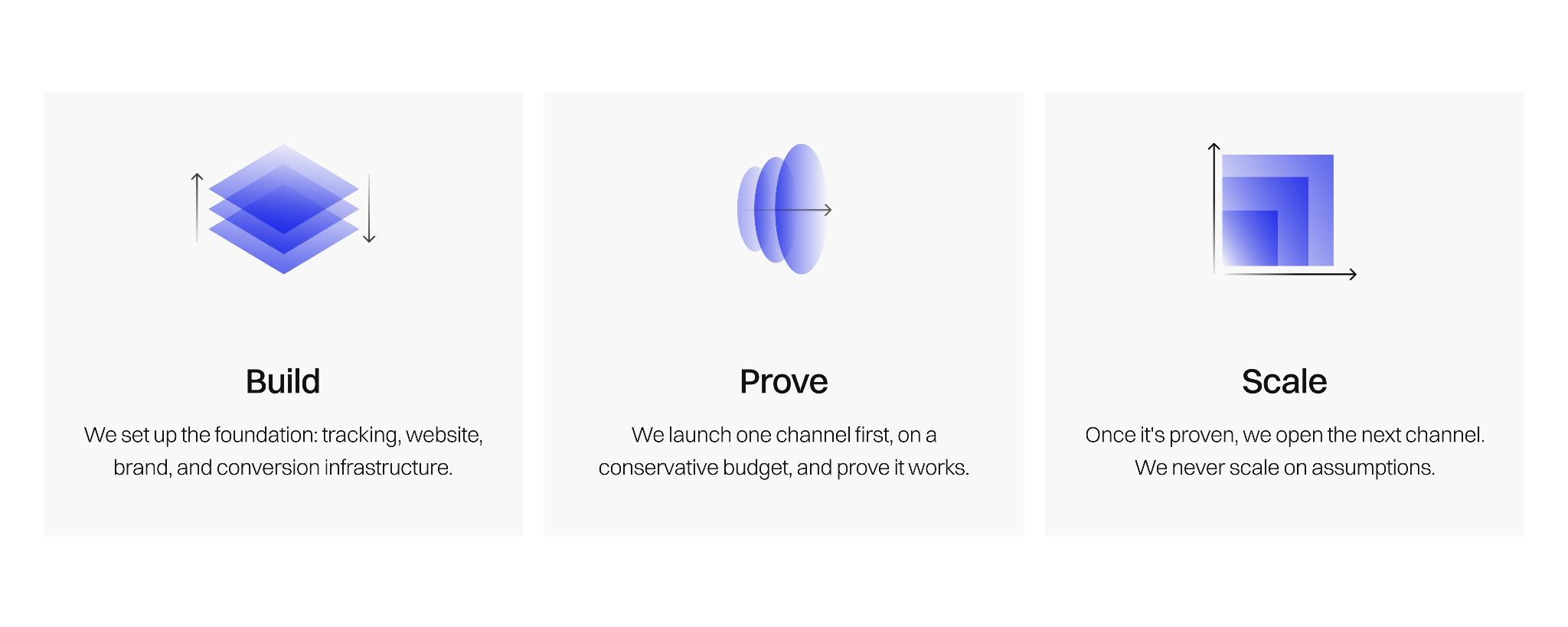
Many agencies begin with campaigns.
Corient begins with systems.
Our philosophy is simple:
Build the right foundations.
Prove what works.
Scale only when the evidence supports it.
This framework, known as The Corient Method™, helps founder-led tech startups replace reactive marketing with predictable customer acquisition.
Build
The Build phase establishes the infrastructure required for sustainable growth.
Rather than immediately launching campaigns, we focus on creating the conditions that allow future marketing investment to succeed.
This includes:
- Positioning and messaging
- Ideal Customer Profile development
- Website strategy
- Conversion optimisation
- Marketing attribution
- CRM alignment
- Lifecycle marketing planning
- Lead generation systems
- Performance dashboards
A key milestone within this phase is the Pilot campaign. Where it's included in your scope, a campaign with a lead form goes live within 30 days while the full build runs over 8 weeks.
Alongside it, the build establishes tracking, identifies conversion opportunities, and gives founders meaningful growth signals before larger investments are made.
Instead of waiting months for clarity, founders gain visibility early into how their acquisition system is performing.
Prove
Once the foundations are established, the next objective is validation.
Rather than spreading the budget across every available marketing channel, Corient focuses on proving one repeatable acquisition engine first.
That may involve:
- Performance advertising
- Organic search
- SEO content clusters
- LinkedIn demand generation
- Lifecycle marketing
- Referral systems
Success isn't measured by clicks or traffic.
It's measured by commercial outcomes such as:
- Qualified pipeline
- SQL generation
- CAC
- Revenue attribution
- Trial activation
- Customer lifetime value
Only after those outcomes are consistently repeatable does the business pass through The Evidence Gate™.
Scale
Scaling becomes significantly less risky once the evidence exists.
Rather than relying on assumptions, founders can confidently expand investment knowing the underlying acquisition system has already been validated.
Scaling may include:
- Expanding paid media investment
- Building additional SEO topic clusters
- Increasing lifecycle automation
- Optimising website conversion
- Launching complementary acquisition channels
- Strengthening customer retention strategies
Because every decision builds upon measurable success, growth becomes more predictable, sustainable, and commercially accountable.
What Successful Founder-Led Tech Startups Do Differently
If you look at founder-led tech companies that consistently grow from seed stage through Series A and beyond, you'll notice they don't simply spend more on marketing.
They build better systems.
Rather than chasing every new channel or growth tactic, they create a repeatable acquisition engine that becomes more efficient over time.
Here are the habits they have in common.
They Build Strategy Before Launching Campaigns
Many startups begin with execution.
They launch Google Ads.
Publish content.
Run LinkedIn campaigns.
Hire an SEO agency.
Implement marketing automation.
Only later do they ask whether these activities actually support the same business objective.
High-growth founders reverse that process.
Before investing heavily in marketing, they define:
- Their Ideal Customer Profile (ICP)
- Their positioning
- Their competitive advantage
- Their customer journey
- Their revenue goals
- The commercial metrics they'll use to measure success
Only then do they decide which marketing channels deserve investment.
This disciplined approach ensures every campaign contributes to a larger growth strategy instead of becoming another disconnected initiative.
They Invest in Repeatable Lead Generation Systems
Predictable growth doesn't come from one successful campaign.
It comes from building systems that consistently generate qualified demand.
For founder-led tech companies, this means creating an acquisition engine where each component supports the next.
For example:
- SEO attracts founders researching solutions.
- Performance advertising accelerates qualified demand.
- A conversion-focused website turns visitors into demo requests or free trials.
- Lifecycle marketing nurtures prospects and improves activation.
- CRM automation supports follow-up and lead qualification.
- Sales receives better-qualified opportunities.
When these elements work together, marketing becomes more predictable and easier to scale.
This is why Corient focuses on building lead generation systems rather than isolated campaigns.
They Measure Commercial Outcomes, Not Marketing Activity
Founders don't need more dashboards.
They need more certainty.
The most successful startups judge marketing by its contribution to business growth.
Instead of celebrating impressions or website visits, they focus on questions such as:
- How much qualified pipeline did marketing generate?
- Which acquisition channel has the lowest CAC?
- How quickly do customers recover acquisition costs?
- Which campaigns influence revenue?
- Which lifecycle improvements increase activation?
- Where are prospects dropping out before becoming customers?
When marketing is measured against commercial outcomes, investment decisions become far more effective.
They Continuously Improve the Customer Journey
Customer acquisition doesn't end when someone submits a form or starts a free trial.
In many SaaS businesses, the biggest opportunities for growth occur after the first interaction.
Successful startups continuously optimise:
- Landing pages
- Demo booking experiences
- Free-trial onboarding
- Email nurturing
- Product activation
- Customer success journeys
- Retention campaigns
Small improvements across each stage often produce significant increases in revenue without requiring additional advertising spend.
They Scale With Confidence, Not Hope
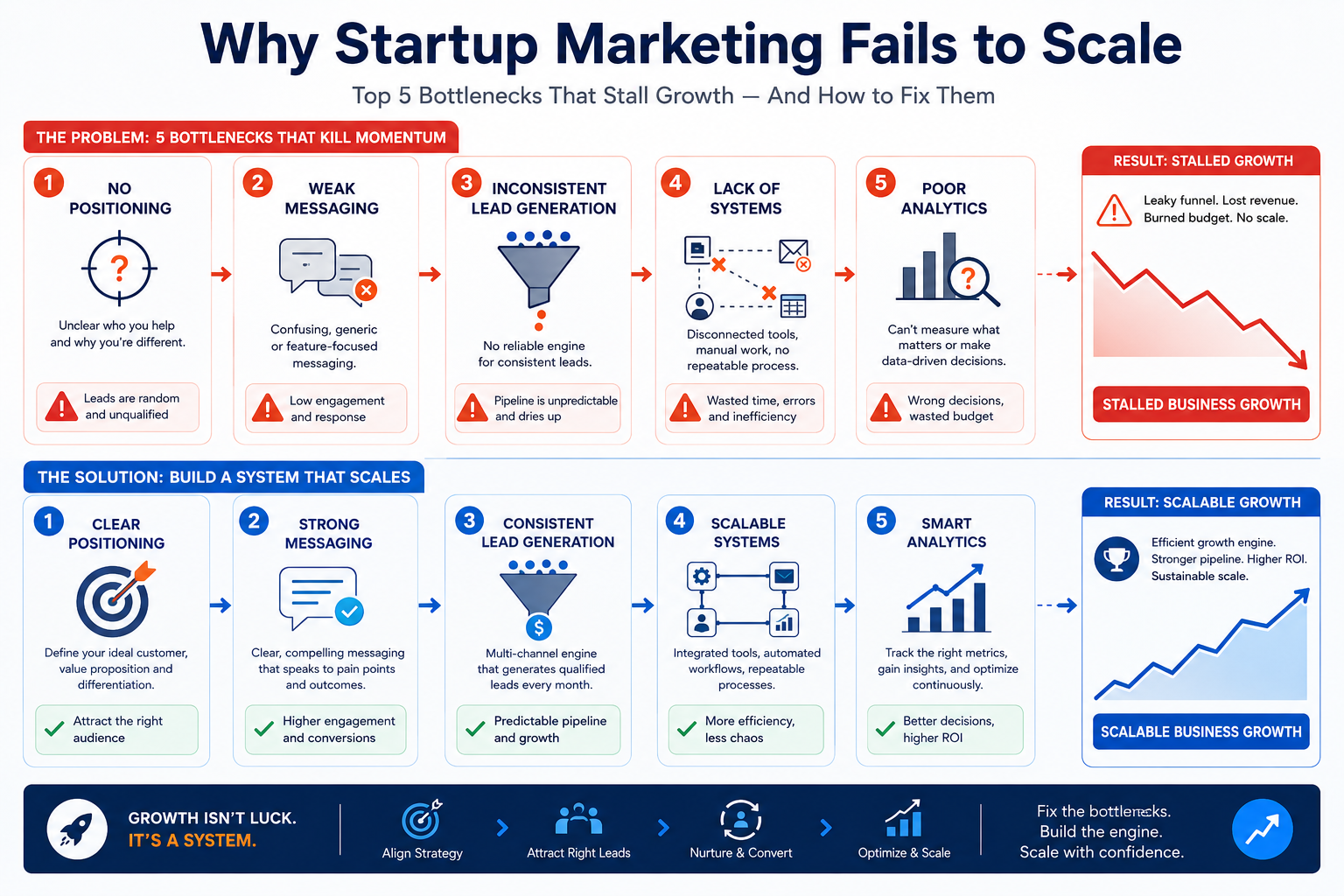
Perhaps the biggest difference between successful startups and struggling ones is how they approach growth.
Rather than assuming more budget will solve every problem, they expand only after proving that their acquisition system is commercially sustainable.
They ask:
- Is our pipeline predictable?
- Is our CAC healthy?
- Can this process be repeated?
- Are conversion rates stable?
- Do we understand why customers buy?
Only after those questions are answered with confidence do they increase investment.
This philosophy sits at the heart of The Corient Method™.
Growth should never depend on optimism.
It should depend on evidence.
A Better Approach to Startup Marketing
Many founders believe scaling requires more campaigns.
More ads.
More content.
More agencies.
In reality, sustainable growth usually comes from improving the system behind those activities.
A stronger startup marketing strategy follows four clear stages.
Step 1: Build the Right Foundations
Before investing heavily in customer acquisition, establish:
- Clear positioning
- Consistent messaging
- A conversion-focused website
- Accurate tracking and attribution
- CRM integration
- Lead generation systems
- Lifecycle marketing processes
Strong foundations reduce wasted spend and improve every future marketing initiative.
Step 2: Prove What Works
Identify one acquisition channel capable of consistently generating a qualified pipeline.
Measure:
- CAC
- SQL generation
- Demo bookings
- Trial activation
- Revenue attribution
- Marketing-sourced pipeline
Validate performance before expanding.
This is where The Evidence Gate™ helps founders remove uncertainty from marketing decisions.
Step 3: Optimise Every Stage
Growth compounds through continuous improvement.
Refine:
- Website conversion rates
- Landing pages
- Messaging
- Paid advertising
- SEO content
- Email automation
- Product onboarding
- Sales handover
Incremental improvements across the customer journey often outperform launching entirely new campaigns.
Step 4: Scale Predictably
Once acquisition becomes repeatable, investment becomes significantly less risky.
Expand strategically by:
- Increasing paid media investment
- Growing SEO topic clusters
- Improving lifecycle marketing
- Launching complementary acquisition channels
- Strengthening customer retention
- Expanding marketing automation
Because every decision is supported by evidence, growth becomes far more predictable.
Frequently Asked Questions
What is a startup marketing strategy?
A startup marketing strategy is a structured framework that helps a business consistently attract, convert, and retain customers. Rather than focusing on individual campaigns, it aligns positioning, lead generation, website strategy, lifecycle marketing, attribution, and conversion optimisation with measurable commercial outcomes.
Why do startup marketing strategies fail?
Most startup marketing strategies fail because they prioritise tactics before building the systems needed to support sustainable growth. Common issues include weak positioning, inconsistent messaging, poor website conversion, incomplete attribution, fragmented marketing channels, and scaling before performance has been validated.
When should a startup scale its marketing?
A startup should scale marketing only after demonstrating that its acquisition system consistently generates a qualified pipeline at a commercially sustainable Customer Acquisition Cost (CAC). Growth decisions should be based on evidence, not assumptions.
What should founders measure first?
Before increasing marketing investment, founders should focus on metrics such as:
- Customer Acquisition Cost (CAC)
- Sales Qualified Leads (SQLs)
- Marketing-attributed pipeline
- Website conversion rate
- Trial-to-paid conversion
- Customer Lifetime Value (LTV)
- Revenue attribution
These metrics provide a clearer picture of business performance than traffic or engagement alone.
Final Thoughts
Many startup marketing strategies don't fail because founders lack ambition.
They fail because businesses try to scale activity before building the systems that make growth repeatable.
More campaigns won't fix unclear positioning.
Higher ad spend won't solve poor conversion.
Additional channels won't compensate for missing attribution.
Founder-led tech companies that grow sustainably take a different approach.
They build strong foundations.
They validate what works.
Then they scale with confidence.
That's the philosophy behind The Corient Method™.
Rather than relying on disconnected campaigns or agency activity, we help founders create evidence-based marketing systems that generate predictable pipelines, improve commercial visibility, and support long-term growth.
Because successful marketing isn't about doing more.
It's about building a system that performs better every quarter.
Ready to Build a Predictable Growth Engine?
If your startup is generating traffic but not a predictable pipeline, or if you're investing in marketing without clear attribution, it's time to take a more strategic approach.
We'll assess your current acquisition system, identify the biggest barriers to scalable growth, and show you how The Corient Method™ can help your business Build, Prove, and Scale with greater confidence. Whether you're refining your website strategy, improving performance advertising, strengthening lifecycle marketing, or creating a more effective lead generation system, you'll leave with practical recommendations grounded in evidence, not guesswork.
Check out more articles below:
- Founder-Led Marketing: Why Startups Need a Marketing System Instead of Just More Campaigns
- Salesforce Marketing Cloud vs HubSpot: Which CRM Wins in 2026?
- How to Set Up Lead Scoring in Salesforce (Step-by-Step Guide)
- CRM Data Hygiene: The 2026 Playbook for Clean, Actionable Data
- CRM Mistakes That Are Costing You Leads (And How to Fix Them)